The Torch 2.12 journey: compile policy, runtime truth, and why version bumps were the easy part
Why framework upgrades in a hybrid training stack are really about re-validating compile behavior, sharding contracts, and backend-specific assumptions.
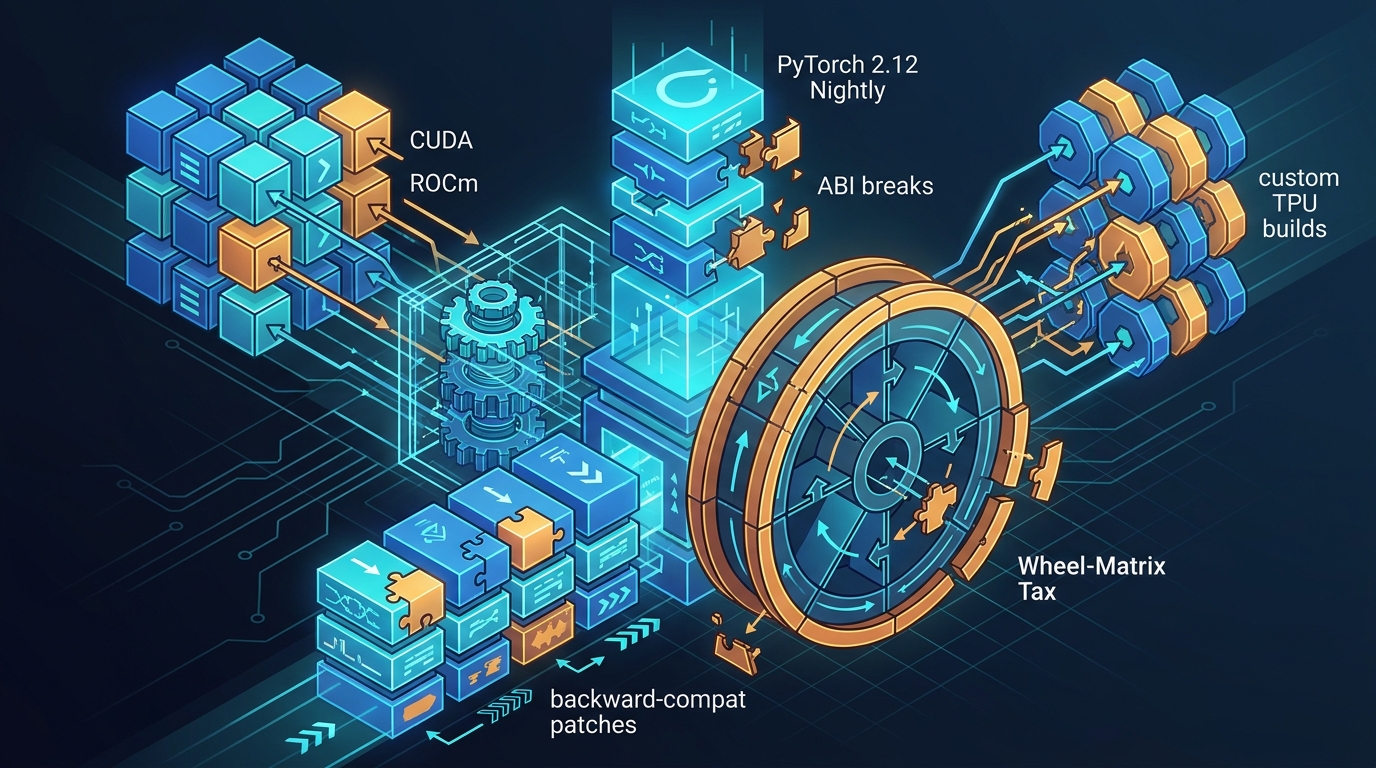
Framework upgrades look simple only at the package-manager layer. In practice, a Torch 2.12-class upgrade is a contract audit: compileQuick term guideCompileWhy MegaCpp treats regional compile as a runtime-boundary decision rather than a blanket switch, and how compile ordering stays tied to distributed…GroundingRegional compile without losing the plot Dynamo and torch.compile Breakage on a Mamba-3 Hybrid behavior, distributed ownership, dynamic-shape assumptions, and backend-specific policies all need to be re-checked on the lanes that actually matter.
Why version bumps are the easy part
In a plain dense model, an upgrade may mostly be about API drift and kernel coverage. In a hybrid training stack, that is not enough. Different lanes stress different surfaces:
- compileQuick term guideCompileWhy MegaCpp treats regional compile as a runtime-boundary decision rather than a blanket switch, and how compile ordering stays tied to distributed…GroundingRegional compile without losing the plot Dynamo and torch.compile Breakage on a Mamba-3 Hybrid and graph-break behavior
- distributed wrappers and local-shard access
- TPU/XLAQuick term guideXLAThe compiler/runtime layer that lowers frontend tensor programs into executable TPU or accelerator graphs, with shape stability and ownership boundaries as the main operational concerns here.GroundingAbout: XLA vs CUDA stack decisions Reference: Torch XLA / PJRT reality Reference: XLA SPMD sharding annotations import order and sharding assumptions
- optimizer-step stability under traced execution
- backend-specific kernel paths
That is why a serious upgrade report is per lane, not global. "Torch upgraded" is weak. "This exact lane advanced under compileQuick term guideCompileWhy MegaCpp treats regional compile as a runtime-boundary decision rather than a blanket switch, and how compile ordering stays tied to distributed…GroundingRegional compile without losing the plot Dynamo and torch.compile Breakage on a Mamba-3 Hybrid, and the next added dimension failed for this concrete reason" is useful.
The real question is runtime policy
What changes across a framework upgrade is often not only code generation quality. The runtimeQuick term guideRuntime boundariesWhy MegaCpp pays first-compile and recompile costs in exchange for steady-state throughput, and the operational rules that keep torch.compile,…GroundingThe Compile-Time Tax We Accept for Runtime Speed Regional compile without losing the plot policy itself can become wrong. A compileQuick term guideCompileWhy MegaCpp treats regional compile as a runtime-boundary decision rather than a blanket switch, and how compile ordering stays tied to distributed…GroundingRegional compile without losing the plot Dynamo and torch.compile Breakage on a Mamba-3 Hybrid warmup step that once helped may become a blocker. A wrapper contract that once exposed a local tensor in one shape may move. A dynamic-shape lane that once reused graphs may start recompiling more often.
That is why the version story needs adjacent receipts such as Torch 2.12 TPU/XLA breakage matrix and the nightly wheel matrix: installability and runtimeQuick term guideRuntime boundariesWhy MegaCpp pays first-compile and recompile costs in exchange for steady-state throughput, and the operational rules that keep torch.compile,…GroundingThe Compile-Time Tax We Accept for Runtime Speed Regional compile without losing the plot truth drift independently. The same receipt chain points to a narrower 2.12 compiler win: assert-once guards and better cache retention around empty tensor-free branches make some dynamic-shape lanes cheaper to keep compiled. The matching warning is that old padded capture or blanket fullgraph=True warmup habits can become the new crash source, so warmup policy has to be revalidated per lane instead of copied forward.
The practical upgrade checklist is therefore narrow:
| Question | Why it matters |
|---|---|
| Does the target lane still compile under its intended policy? | old warmup or forcing assumptions may have become the new bug |
| Do local-shard helpers still see the tensor view they expect? | wrapper and sharding contracts can drift across versions |
| Do TPU/XLA and CUDA paths still agree on the same high-level model contract? | backend divergence often shows up only after launch |
| Are claims about recompilation still true on the exact validated lane? | "eventually runs" is weaker than "runs within the intended compile budget" |
Why hybrid stacks raise the bar
Once the model mixes attention-heavy blocks, state-space or recurrent-style blocks, and MoE-style conditional paths, the framework surface is wider:
- attention-heavy paths stress kernels, masks, and cache behavior
- recurrent or state-space blocks stress custom autograd and state handling
- conditional or sparse paths stress specialization and compileQuick term guideCompileWhy MegaCpp treats regional compile as a runtime-boundary decision rather than a blanket switch, and how compile ordering stays tied to distributed…GroundingRegional compile without losing the plot Dynamo and torch.compile Breakage on a Mamba-3 Hybrid caching
- auxiliary instrumentation stresses scalar handling and host-device sync boundaries
That is why a Torch journey should be documented as a frontier, not a slogan. Start with a known-good lane, add one dimension, and record the next honest failure.
What good upgrade reporting looks like
The best upgrade notes do three things:
- name the exact lane under discussion
- name the exact failure surface
- separate workaround, validated default, and still-open risk
That reporting style matters because broad claims age badly. "CompileQuick term guideCompileWhy MegaCpp treats regional compile as a runtime-boundary decision rather than a blanket switch, and how compile ordering stays tied to distributed…GroundingRegional compile without losing the plot Dynamo and torch.compile Breakage on a Mamba-3 Hybrid is fixed" or "distributed is solved" quickly become ambiguous. Safer wording is much narrower:
| Claim type | Safer wording |
|---|---|
| compile progress | this lane advances under lazy compile with cache growth |
| recompilation | this validated lane did not show extra recompiles in the checked path |
| distributed behavior | the local-shard helper path was re-validated on this recipe |
| backend support | the TPU and GPU lanes preserved the same high-level model contract on their respective runtimes |
Why local ownership still matters
Hybrid stacks often contain helper code that expects a local tensor view, or that resolves distributed wrappers before applying custom logic. That means an upgrade has to be read through ownership boundaries, not only top-level APIs. If the wrapper behavior changes, the breakage may show up far away from the nominal version bump.
On the distributed side, 2.12 pushes the story toward DeviceMeshQuick term guideDeviceMeshPyTorch's named logical device grid for distributed placement. It says which ranks belong to each parallel axis before DTensor or FSDP2 sharding metadata is applied.GroundingAbout: EP / PP / TP / CP / SP / DP overview Example: 3D parallelism sample Reference: FSDP on CUDA and Megatron DDP plus functional sharding instead of older wrapper assumptions. That can reduce some trace-boundary friction, but it also moves the migration burden into helper code: local-shard access, resume logic, and checkpoint ownership need to be revalidated under the same meshQuick term guidemeshThe named device grid that defines which logical axis maps to which TPU or distributed-device axis before sharding annotations make sense.GroundingAbout: XLA SPMD sharding annotations Example: 3D parallelism sample Reference: FSDP2 on XLA TPU contract instead of assuming an older full-tensor path. FSDP2 on XLA TPU, FSDP2 pain and payoff, and Checkpoint format and resume are the neighboring receipts for that boundary.
The same caution applies to compiled execution. A lane may appear healthy because it eventually runs, while still violating the intended no-recompile or bounded-recompile story. Conditional routing, custom autograd helpers, and auxiliary runtimeQuick term guideRuntime boundariesWhy MegaCpp pays first-compile and recompile costs in exchange for steady-state throughput, and the operational rules that keep torch.compile,…GroundingThe Compile-Time Tax We Accept for Runtime Speed Regional compile without losing the plot code are the easy places to overclaim progress after a 2.12-class move. That is why graph recompilation hell, the checked-in Compile/runtime receipt sample, and the Regional compile runtime sample belong in the same reading chain as this upgrade note.
The same audit applies to instrumentation and sync boundaries. Stream choice, explicit synchronization, and random-state ownership sit outside the headline kernels, but they still shape whether a compiled lane preserves the runtimeQuick term guideRuntime boundariesWhy MegaCpp pays first-compile and recompile costs in exchange for steady-state throughput, and the operational rules that keep torch.compile,…GroundingThe Compile-Time Tax We Accept for Runtime Speed Regional compile without losing the plot budget it claims to preserve. That is why this upgrade note belongs next to Regional compile without losing the plot: the upgrade story is not only "did it compileQuick term guideCompileWhy MegaCpp treats regional compile as a runtime-boundary decision rather than a blanket switch, and how compile ordering stays tied to distributed…GroundingRegional compile without losing the plot Dynamo and torch.compile Breakage on a Mamba-3 Hybrid" but also "did the surrounding runtimeQuick term guideRuntime boundariesWhy MegaCpp pays first-compile and recompile costs in exchange for steady-state throughput, and the operational rules that keep torch.compile,…GroundingThe Compile-Time Tax We Accept for Runtime Speed Regional compile without losing the plot stay honest after the version move."
The habit worth keeping
The best habit from any major framework migration is frontier tracking:
- keep one passing baseline
- add one extra runtimeQuick term guideRuntime boundariesWhy MegaCpp pays first-compile and recompile costs in exchange for steady-state throughput, and the operational rules that keep torch.compile,…GroundingThe Compile-Time Tax We Accept for Runtime Speed Regional compile without losing the plot dimension at a time
- record the first failing frontier
- write that back into the docs immediately
For a Torch 2.12-class migration, that is more useful than an all-at-once compatibility claim. It keeps the upgrade story honest and makes later regression hunts cheaper.
Frequently asked questions
Why keep both an XLA breakage matrix and a nightly wheel matrix?+
Why mention auxiliary runtime code in a framework-upgrade article?+
When should compile warmup policy be revalidated after a framework bump?+
Terms used in this article
Start here for quick definitions, then follow the linked posts for deeper context.
The named device grid that defines which logical axis maps to which TPU or distributed-device axis before sharding annotations make sense.
PyTorch's named logical device grid for distributed placement. It says which ranks belong to each parallel axis before DTensor or FSDP2 sharding metadata is applied.
Why MegaCpp treats regional compile as a runtime-boundary decision rather than a blanket switch, and how compile ordering stays tied to distributed…
Why MegaCpp pays first-compile and recompile costs in exchange for steady-state throughput, and the operational rules that keep torch.compile,…
PyTorch's Fully Sharded Data Parallel v2 wrapper API. On CUDA it shards parameters, gradients, and optimizer state across the data-parallel group; in the TPU/XLA posts here it is usually a memory-goal analogy, not the actual eager wrapper mechanism.
The compiler/runtime layer that lowers frontend tensor programs into executable TPU or accelerator graphs, with shape stability and ownership boundaries as the main operational concerns here.