Data Enhancements: Why structure IDs, AST features, and the Clang graph earn their cost
The structural metadata layered on top of raw C++ source: structure IDs, chunk boundaries, call edges, type edges, tree-sitter AST features, and the optional libclang semantic graph. What each one is for, what the ablations justified, and what we pay in storage and runtime.
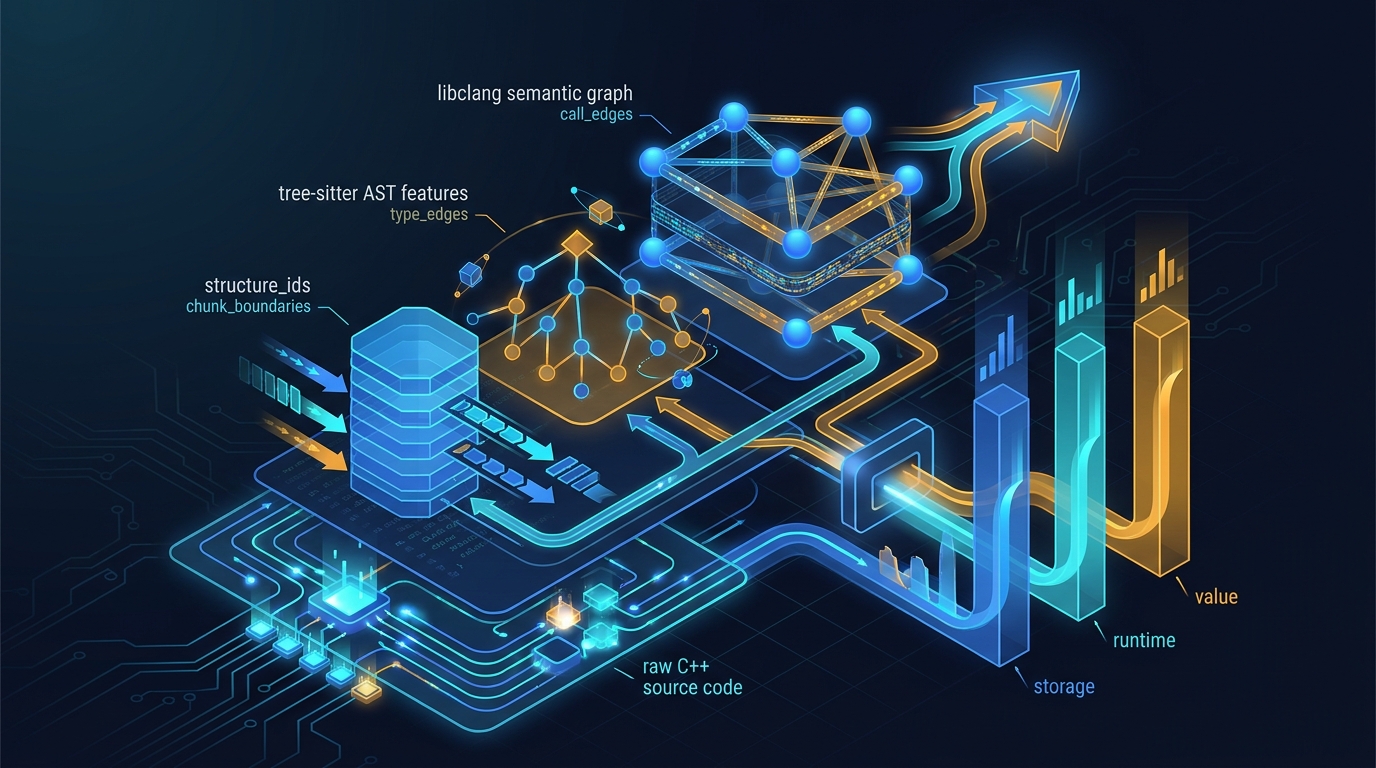
Raw C/C++ source is sequence-of-bytes, which is what every general-purpose language model has to make do with. We pay extra to do better. The enriched parquet schema annotates each token with five pieces of structural metadata, every chunk with a typed boundary plus a dependency level, and every document with two graphs (call edges and type edges). On top of that, the long-context lanes consume an optional libclang semantic graph that resolves what tree-sitter can only approximate. This post is the engineering case for each of those layers: what it is, why we added it, what the ablation said, and what it costs. For first touch, structure_ids are token-level category labels, chunk_boundaries are typed spans with dependency depth, call_edges and type_edges are the document-level relations between those spans, and the optional libclang semantic graph is the resolved cross-file call/type edge set emitted under a real compile contract. For the producer-side path, pair it with the broader C++ data preparation pipeline; for the runtime-side cost story, the closest neighbor is dataloader throughput and stalls.
Why MegaCpp cares about this
Code is a structured artifact pretending to be flat text. A function body is a span. A class declaration carries an implicit dependency on its base class. A #include is a routing hint. A call from f to g is the strongest signal in the file about what f does. None of that is in the bytes - it is recoverable, but only if you spend compute outside the model to parse it. The choice we made is to spend that compute once, offline, materialize the result into the parquet record as token-aligned columns, and let the model read it for free at training time.
The alternative is to make the model rediscover this structure from raw bytes. Some of it does, eventually. The empirical observation in our ablation logs is that the structure-aware path consistently wins on val_bpb at fixed compute, and the throughput cost - once we engineer it correctly - is smaller than the win. The interesting engineering is in the qualifier "once we engineer it correctly." The naive implementation is several times slower than the model and a graph cache nightmare on TPU.
What we built in MegaCpp
Five distinct enhancement layers, each with its own producer, consumer, and ablation history.
Layer 1: per-token structure_ids. Nine StructureCategory entries (OTHER, PREAMBLE, FUNC_SIGNATURE, FUNC_BODY, CLASS_DECL, CLASS_MEMBER, COMMENT, TYPEDEF, NAMESPACE) produced by the semantic chunker as per-character category bytes and materialized to token level via first-character sampling. The consumer is StructureEmbedding: the stacked lookup path that turns these integer metadata planes into additive token features. It is projected through a low-rank bottleneck (default bottleneck_dim=64) and zero-initialized so the path is identity at start.
Layer 2: chunk boundaries with dependency levels. A chunk_boundaries column of list<struct {start, end, kind, name, dep_level}>. The chunk kinds are the same nine categories as structure_ids, lifted to the chunk level so a whole function body is one chunk rather than per-token bytes. dep_level is the BFS depth of the chunk in the document's local dependency graph (a function called only by main is at dep_level 0; a helper called by that function is at dep_level 1; and so on). The consumer feeds dep_level as a second structure embedding, and the chunk boundaries themselves drive the TreeFFN message-passing path: a chunk-graph updater that pools token states to chunks, exchanges messages over relation edges, and scatters the result back to tokens.
Layer 3: call_edges and type_edges. Two list<struct {from, to}> columns, indices into the chunk array. These are what make the document a graph instead of a sequence. They originally fed a learned per-head relation-bias path that added a chunk-pair bias term to the attentionQuick term guideAttentionThe token-mixing path that turns Q/K/V style projections into context-aware activations. On MLA pages here it refers to the concrete attention module boundary, not the A/M/E/R block-family shorthand.GroundingAbout: fused MLA on NVIDIA Reference: shared MLA adapter boundaries Reference: public-safe MLA integration patterns logits. We later removed that path but kept the edges in the parquet because they still drive the TreeFFN path and the offline analytics; their cost is small and the optionality is cheap.
Layer 4: tree-sitter AST features. Three per-token columns : ast_depth (clamped to 63), sibling_index (clamped to 63), and ast_node_type (256-bucket categorization via a shared node-type map). Buckets group semantically similar nodes (declarations 1-9, statements 10-19, expressions 20-29, types 30-39, literals 40-49, operators 50-59, and so on). The producer and consumer agree on numbering so producer paths stay in sync. The consumer is the same StructureEmbedding, with three extra sub-tables folded into the stacked lookup.
Layer 5: the libclang semantic graph (optional). This is the only layer that requires a real C/C++ frontend instead of an AST parser. The semantic indexerQuick term guideSemantic indexingThe structure-aware indexing lane that turns compile commands and parsed symbols into reusable training metadata.GroundingAbout: Clang semantic indexing About: compile commands and semantic graphs Example: semantic indexing notes drives libclang against each project's compile command databaseQuick term guidecompile command databaseThe compilation-command manifest that grounds semantic indexing, compiler receipts, and structure-aware data enrichment.GroundingAbout: compile commands and semantic graphs Example: compile commands context example Example: semantic indexing notes, walks the AST through the proper translation unit, and emits cross-file resolved relationships: which symbol does this foo() call resolve to under namespaces, overloads, and templates; which type does this declaration depend on through the actual symbol table. The output replaces tree-sitter's intra-document call_edges/type_edges with cross-document, semantically resolved edges plus per-file compile_commandsQuick term guidecompile command databaseThe compilation-command manifest that grounds semantic indexing, compiler receipts, and structure-aware data enrichment.GroundingAbout: compile commands and semantic graphs Example: compile commands context example Example: semantic indexing notes provenance under build_info. This is what feeds the long-context curriculum lanes; tree-sitter graphs are fine at 16K, the libclang graphs are what justify the 64K and 128K budgets.
On the consumer side, PlatformEmbedding is a related-but-separate enhancement: a per-document multi-hot platform-label embedding (nn.EmbeddingBag over a 113-entry vocabulary covering OS, GPU, and architecture targets) that broadcasts a single vector across the sequence. The platform labels are produced by the platform scanner described in the public dataQuick term guideData pipelineAn honest walkthrough of how the MegaCpp training data pipeline was built — source selection, filtering, dedup, tokenization, document masking, and…GroundingBuilding the C++ Training Data Pipeline: What Worked, What Broke SLM data: what the pipeline optimizes for and why the loader contract matters most-preparation notes. It is not strictly part of the structural enrichment, but it ships through the same parquet contract and falls back zero-initialized like the rest.
How it lands in MegaCpp
The producer side ships intact. MegaCpp relies on separately maintained semantic-chunking and semantic-indexing tooling at pinned versions; vendoring those binaries would mean owning several thousand lines of actively maintained Rust and libclang glue code, and the dependency is the smaller cost. The schema is canonical, and the consumer-side tolerant loader is the source of truth for what a record can look like.
The consumer side is where MegaCpp makes choices. StructureEmbedding lifts as-is, including the stacked-embedding bottleneck optimization and the active_components selector (so a deployment can ship core - structure plus dep_level only - without paying for AST features). PlatformEmbedding lifts as-is. The learned relation-bias path was dropped across presets: at scale it did not improve over structure_emb + tree_ffn, and it cost test surface, auto-fit accounting, and wrapper code. Edges remain in the parquet because they feed tree_ffn.
That tolerant-loader boundary is narrower than it sounds. Optional columns keep
older or partially populated shards readable, which is why the checked-in
loader enriched columns sample
falls back to deterministic defaults for malformed or absent enriched JSON. But
once a structure-aware run enables a feature, the model-side contract gets
stricter: the planes that actually reach
Structure embedding components sample
still need token-for-token alignment with input_ids, or the feature is
invalid rather than merely absent.
The TreeFFN message-passing module is being moved behind a feature flag that defaults on for the structure-aware presets and off for the dense reference. It is what consumes chunk_boundaries, dep_levels, and the edge columns to compute a per-chunk message-passed representation that gets pooled back to per-token. We are not lifting it as-is to a kernel path; the per-batch chunk topology is too irregular to compile usefully. The TPU fast path is a bmm-based pooling plus cumsum-based top-K neighbor selection that avoids the scatter/searchsorted/topk/nonzero ops that lower badly on XLA. That fast path is what makes the structure features near-zero-cost on TPU at our hybrid-preset scale.
Ablations and what we kept
One representative ablation sweep kept model geometry, step count, and hardware tier fixed while varying only the feature stack. Throughput (median tok/sec) and Val BPB (validation bits per byte) at step 50:
- bare baseline (no structure, no enriched): 595,585 tok/sec, 2.493 BPB
- structure-aware runtime without enriched dataQuick term guideData pipelineAn honest walkthrough of how the MegaCpp training data pipeline was built — source selection, filtering, dedup, tokenization, document masking, and…GroundingBuilding the C++ Training Data Pipeline: What Worked, What Broke SLM data: what the pipeline optimizes for and why the loader contract matters most: 496,962 tok/sec, 2.299 BPB, -17% throughput
- full stack (enriched +
structure_emb+tree_ffn+ the rest of the current runtime feature stack): 316,047 tok/sec, 2.287 BPB, -47% throughput
The full stack is the best quality at the worst throughput. The middle lane is the practical sweet spot. The marginal effect of enriched dataQuick term guideData pipelineAn honest walkthrough of how the MegaCpp training data pipeline was built — source selection, filtering, dedup, tokenization, document masking, and…GroundingBuilding the C++ Training Data Pipeline: What Worked, What Broke SLM data: what the pipeline optimizes for and why the loader contract matters most plus structure features is a small BPB improvement at 36% throughput cost. We kept the structure-aware path because the BPB win compounds across the curriculum and the throughput cost is recoverable through engineering. The pretokenized-vs-char-level fix recovered roughly 4x in the dataloader (4,172 to 17,297 tok/sec). The eager-segment-materialization fix recovered another 2.4x (562 to 1,324 tok/sec). The conv1d-vs-Python-loop fix recovered 22% on the Mamba doc-mask path. The structure_emb bottleneck dim 64 recovered 23% on the structure-embedding-enabled runs.
The accelerator-kernel breakdown told a more flattering story than the ablation table alone. A full-feature profile (depth-52 hybrid preset, 4.1B, all features, 75.0s self CUDA) versus a stripped-down comparison run (972M, 8 experts, no enriched) came out at -0.6s difference between enriched and the closest mod-bypass variant, which is effectively within noise. The practical reading is that enriched features such as stacked embeddings and TreeFFN were not the dominant bottleneck once the loader-side issues were fixed.
The features that did not survive: the learned relation-bias path was removed because at scale it did not improve over the structure_emb + tree_ffn combination. The relation-bias experiments stayed promising in synthetic benchmarks but consistently failed to add meaningful BPB on real corpora once the other paths were enabled. The practical lesson is simple: do not re-add a learned per-head pair bias on top of TreeFFN without an ablation that shows it beats the cost.
The features that we ship but that are still under evaluation: the ast_depth / sibling_index / ast_node_type columns. They land in the parquet, they feed StructureEmbedding when active_components="all", and stable training runs show the configuration works. We do not have a clean ablation showing they add BPB independently of structure_ids and dep_levels. The cost is small - three extra uint8 arrays per document and three more sub-tables in the bottlenecked embedding lookup - and removing them later is a one-line config change. They stay opt-out, not opt-in.
The optional libclang semantic graph is the most expensive enhancement: it needs compile command databaseQuick term guidecompile command databaseThe compilation-command manifest that grounds semantic indexing, compiler receipts, and structure-aware data enrichment.GroundingAbout: compile commands and semantic graphs Example: compile commands context example Example: semantic indexing notes per project, libclang, a real build environment, and incremental history walking. We fixed the obvious bugs: the compilation database being generated once and then reused with stale flags across revisions, thread-based workers deadlocking on hung clang translation units, and giant working trees stalling under full history walks. The fixes were regeneration when build metadata changes, process-based workers, and direct object extraction instead of heavyweight checkout churn. The operational overhead is real; we keep it because it is the only producer whose call edges we trust at long context.
Production checklist
- Every enhancement column is optional in the loader. Missing or shape-invalid columns fall back to deterministic defaults; partial trust is a correctness bug.
StructureEmbeddingandPlatformEmbeddingare zero-initialized. Adding them to an existing checkpoint must produce zero contribution at start.- The stacked-embedding bottleneck (
bottleneck_dim=64) is on by default for structure features. Without it the path is 23% slower for no quality gain. - The pretokenized columns are mandatory in the production dataQuick term guideData pipelineAn honest walkthrough of how the MegaCpp training data pipeline was built — source selection, filtering, dedup, tokenization, document masking, and…GroundingBuilding the C++ Training Data Pipeline: What Worked, What Broke SLM data: what the pipeline optimizes for and why the loader contract matters most path. The char-level columns exist only as input to the offline materializer.
lazy_enriched_segment_materialization=Falsewhenever the full structure stack is enabled - this gating recovers a 2.4x throughput regression and is non-negotiable for the full-enriched config.- The TreeFFN TPU fast path is bmm-based pooling plus cumsum-based top-K. No
scatter, nosearchsorted, notopk, nononzeroin the structure consumer. Each one breaks the XLA static-shape contract. - The libclang lane uses
ProcessPoolExecutor, notThreadPoolExecutor, with a per-revision lifecycle. - The libclang lane regenerates compile command databaseQuick term guidecompile command databaseThe compilation-command manifest that grounds semantic indexing, compiler receipts, and structure-aware data enrichment.GroundingAbout: compile commands and semantic graphs Example: compile commands context example Example: semantic indexing notes whenever build files change across revisions. Generating it once and reusing it later is silently wrong.
- The Aho-Corasick platform scanner is fast enough to run inline; do not move it offline as an "optimization."
- The chunk-kind whitelist for chunk-level dedup is a different list from the chunk-kind set the model consumes through
chunk_boundaries. Do not collapse them. - The learned relation-bias path is removed and stays removed unless an ablation shows it beats
structure_emb+tree_ffnat real scale.
Enhancement snapshot
| Layer | What it adds | Why it matters |
|---|---|---|
| Doc-mask | loss mask over prose/comments | prevents natural-language overfit on code loss |
| Include graph | cross-file context | header-aware completion quality |
| Semantic blocks | function/class boundaries | long-context packing without chopping symbols |
| Compile probes | sanity builds on a fraction | catches corpus-wide syntax regressions |
enhancements:
  doc_mask: { weight: 0.1, scope: ["comments", "markdown"] }
  include_graph: { depth: 2 }
  semantic_blocks: { min_tokens: 32, max_tokens: 2048 }
  compile_probes: { sample: 0.005, timeout_s: 30 }
If you care about how these columns become versioned dataset promises rather than one-off enrichments, pair this write-up with dataset versions: the long-form ablation history and C++ data versioning and schema.
Frequently asked questions
Why keep enhancement columns that are only optional at load time?+
Why is libclang treated separately from tree-sitter?+
Why keep coverage labels on build-aware semantic output?+
Which companion post should I read if I care about versioning rather than features?+
Which checked-in files show the structure-aware contract fastest?+
Terms used in this article
Start here for quick definitions, then follow the linked posts for deeper context.
The compilation-command manifest that grounds semantic indexing, compiler receipts, and structure-aware data enrichment.
The structure-aware indexing lane that turns compile commands and parsed symbols into reusable training metadata.
An honest walkthrough of how the MegaCpp training data pipeline was built — source selection, filtering, dedup, tokenization, document masking, and…
The per-token training mask that decides which positions contribute to loss after packing, FIM rearrangement, or documentation-aware masking.
The token-mixing path that turns Q/K/V style projections into context-aware activations. On MLA pages here it refers to the concrete attention module boundary, not the A/M/E/R block-family shorthand.
Why packed rows are the real boundary between the data pipeline and the model, and why MegaCpp treats row packing as a schema contract rather than a…