TPU v6e Host Bringup
What makes a TPU v6e host bringup credible: pinned setup, environment restore, validation ladders, and durable runtime notes.
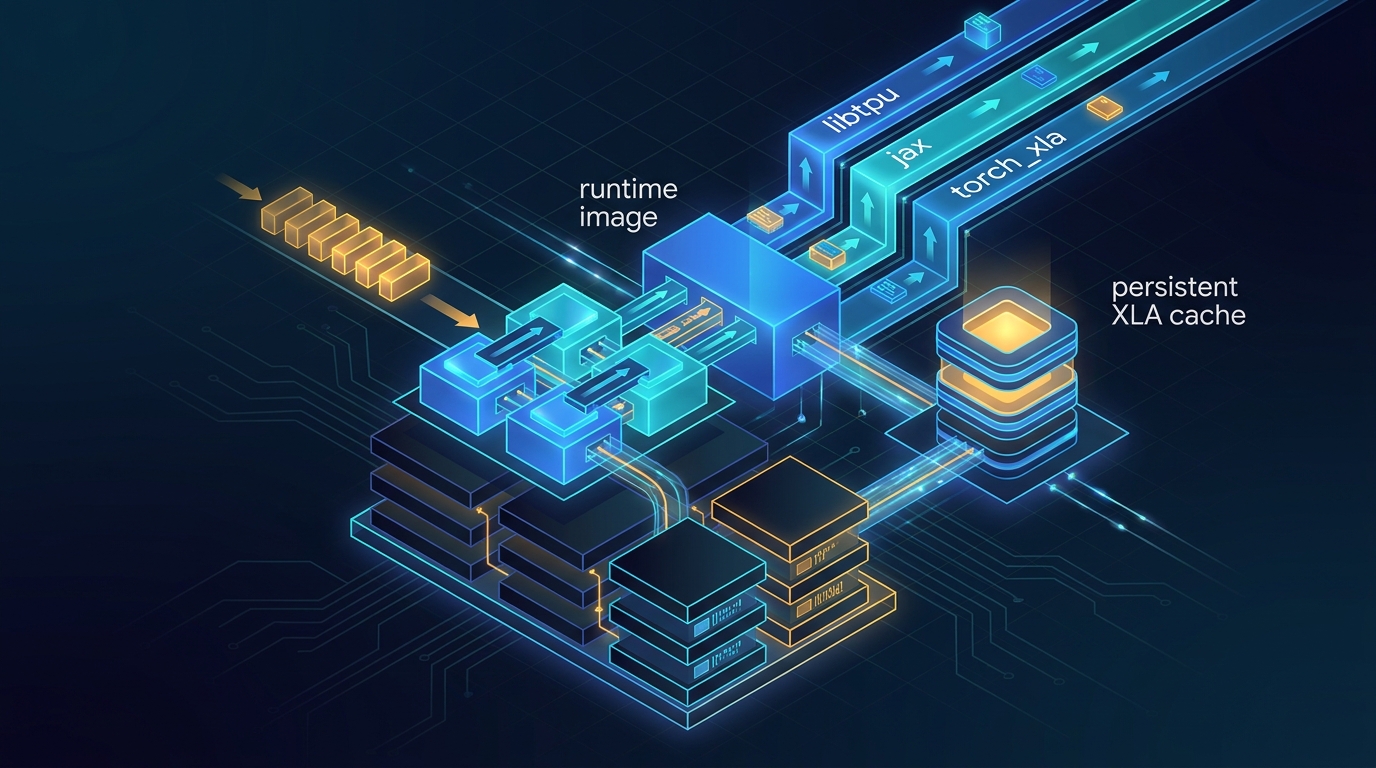
This post is about what makes TPUQuick term guideTPUGoogle's Tensor Processing Unit accelerator/runtime surface, where the important boundary in these posts is usually XLA or PJRT ownership rather than handwritten GPU kernels.GroundingAbout: Torch XLA / PJRT reality Reference: libtpu / PJRT ownership boundaries v6e host bringup real in practice. Not in the sense that a VM booted or that one synthetic demo ran, but in the stronger sense that the environment became reproducible enough to support real model work. The important part is not one magical launch command. It is the combination of pinned setup, environment restore, cache discipline, feature-ladder validation, and honest runtime notes.
Why This Is Hard
TPUQuick term guideTPUGoogle's Tensor Processing Unit accelerator/runtime surface, where the important boundary in these posts is usually XLA or PJRT ownership rather than handwritten GPU kernels.GroundingAbout: Torch XLA / PJRT reality Reference: libtpu / PJRT ownership boundaries bringup is never just "install package X and start trainingQuick term guideTrainingA grounded walkthrough of how the project approaches small-language-model training: explicit stack specs, memory-first patches, hybrid blocks, and…GroundingSLM training in MegaCpp: what the stack optimizes for and what stays explicit Training speed anatomy on H200." A healthy lane depends on several moving layers lining up at the same time:
- the TPUQuick term guideTPUGoogle's Tensor Processing Unit accelerator/runtime surface, where the important boundary in these posts is usually XLA or PJRT ownership rather than handwritten GPU kernels.GroundingAbout: Torch XLA / PJRT reality Reference: libtpu / PJRT ownership boundaries VM image and host packages
- the framework runtime, especially
torch-xlaand PJRTQuick term guidePJRTThe TPU runtime interface between frontend code and the backend executor; it is the ownership seam between JAX/Torch-XLA frontends and libtpu.GroundingAbout: libtpu / PJRT ownership boundaries About: Torch XLA / PJRT reality Example: TPU backend ownership note behavior - any JAXQuick term guideJAXA separate frontend above PJRT/libtpu. In these TPU posts it mainly matters as the owner of NamedSharding, PartitionSpec, and the optional call_jax or Pallas-adjacent bridge lanes.GroundingAbout: libtpu and JAX interaction Reference: libtpu / PJRT / JAX ownership boundaries Reference: Pallas on TPU-side or auxiliary packages that share the environment
- the model canary that first exercises compilation and runtime state
- cache, filesystem, and environment-variable assumptions
Those layers drift independently. TPUQuick term guideTPUGoogle's Tensor Processing Unit accelerator/runtime surface, where the important boundary in these posts is usually XLA or PJRT ownership rather than handwritten GPU kernels.GroundingAbout: Torch XLA / PJRT reality Reference: libtpu / PJRT ownership boundaries VM images change. torch-xla and PJRTQuick term guidePJRTThe TPU runtime interface between frontend code and the backend executor; it is the ownership seam between JAX/Torch-XLA frontends and libtpu.GroundingAbout: libtpu / PJRT ownership boundaries About: Torch XLA / PJRT reality Example: TPU backend ownership note behavior evolves. Python wheels and JAXQuick term guideJAXA separate frontend above PJRT/libtpu. In these TPU posts it mainly matters as the owner of NamedSharding, PartitionSpec, and the optional call_jax or Pallas-adjacent bridge lanes.GroundingAbout: libtpu and JAX interaction Reference: libtpu / PJRT / JAX ownership boundaries Reference: Pallas on TPU-side packages can move. Compile behavior depends on model structure and on which first canary actually exercises the graph. If you do not pin and rehydrate the environment carefully, every runtime symptom starts looking the same.
What Actually Makes The Host Usable
The first requirement is a coherent base stack. Google's Cloud TPUQuick term guideTPUGoogle's Tensor Processing Unit accelerator/runtime surface, where the important boundary in these posts is usually XLA or PJRT ownership rather than handwritten GPU kernels.GroundingAbout: Torch XLA / PJRT reality Reference: libtpu / PJRT ownership boundaries docs define the TPUQuick term guideTPUGoogle's Tensor Processing Unit accelerator/runtime surface, where the important boundary in these posts is usually XLA or PJRT ownership rather than handwritten GPU kernels.GroundingAbout: Torch XLA / PJRT reality Reference: libtpu / PJRT ownership boundaries VM model, supported software entrypoints, and versioned runtime guidance. The PyTorch/XLAQuick term guideXLAThe compiler/runtime layer that lowers frontend tensor programs into executable TPU or accelerator graphs, with shape stability and ownership boundaries as the main operational concerns here.GroundingAbout: XLA vs CUDA stack decisions Reference: Torch XLA / PJRT reality Reference: XLA SPMD sharding annotations docs define the PJRTQuick term guidePJRTThe TPU runtime interface between frontend code and the backend executor; it is the ownership seam between JAX/Torch-XLA frontends and libtpu.GroundingAbout: libtpu / PJRT ownership boundaries About: Torch XLA / PJRT reality Example: TPU backend ownership note and runtime model from the framework side. A good bringup flow starts by choosing a stack that is internally consistent with those public docs instead of mixing arbitrary package versions until something launches.
The second requirement is environment restore. A host is not really up if only the current shell knows how to run the job. Environment recreation has to be explicit enough that another engineer can return to the same VM or a fresh VM and rebuild the same stack without guesswork. In practice that means scripts or setup notes that pin the critical packages, document the environment variables, and make cache and working-directory assumptions visible. The checked-in XLAQuick term guideXLAThe compiler/runtime layer that lowers frontend tensor programs into executable TPU or accelerator graphs, with shape stability and ownership boundaries as the main operational concerns here.GroundingAbout: XLA vs CUDA stack decisions Reference: Torch XLA / PJRT reality Reference: XLA SPMD sharding annotations runtime samples also keep one important boundary explicit: backend target and compile-cache policy belong to the launcher contract before the runtime initializes, not to ad hoc shell recovery afterward.
The smallest durable restore proof is two-part. First, the runtime probe has to show more than an installed package: it needs a live device-facing torch_xla.runtime or xla_model probe. Then the next small canary has to run under the same cache path and compile-control contract, so the team can tell a restored execution lane from a silently rebuilt cold start. That is why this bringup lane pairs the checked-in TPU runtime probe sample with the XLA compile/runtime controls sample before treating a rerun as proof.
The cache proof should also look at the runtime counters, not just wall-clock time. A cold probe may legitimately show CompileTime samples, but a restored probe for the same tiny graph should keep compilation flat while execution counters move. If CompileTime climbs again, the host may still be usable, but the restore did not prove the same graph and cache contract.
The third requirement is a validation ladder. After the setup script, the strongest operational artifact is a disciplined sequence of increasingly complex canaries. Start with the smallest dense or single-feature job that exercises the stack, then add one structural feature at a time. This is the right response to TPUQuick term guideTPUGoogle's Tensor Processing Unit accelerator/runtime surface, where the important boundary in these posts is usually XLA or PJRT ownership rather than handwritten GPU kernels.GroundingAbout: Torch XLA / PJRT reality Reference: libtpu / PJRT ownership boundaries bringup complexity.
There is nothing exotic about that logic, but many TPUQuick term guideTPUGoogle's Tensor Processing Unit accelerator/runtime surface, where the important boundary in these posts is usually XLA or PJRT ownership rather than handwritten GPU kernels.GroundingAbout: Torch XLA / PJRT reality Reference: libtpu / PJRT ownership boundaries writeups skip it. They jump from environment setup to a large hybrid recipe and then act surprised when they cannot tell infrastructure breakage from model breakage. The ladder is what turns a TPUQuick term guideTPUGoogle's Tensor Processing Unit accelerator/runtime surface, where the important boundary in these posts is usually XLA or PJRT ownership rather than handwritten GPU kernels.GroundingAbout: Torch XLA / PJRT reality Reference: libtpu / PJRT ownership boundaries host from "alive" into "interpretable."
What Stays Local And What Must Stay Durable
A good public writeup keeps the right facts and drops the wrong ones. It should preserve the local facts that remain true: which stack launched, which scripts were used, which validation rungs were stable, and which runtime notes were observed. It should not overfit transient platform facts into timeless operator truth.
That distinction is good engineering hygiene. A maintainer can update stack pins or launch flow without rewriting the meaning of an older receipt, because the receipt was already careful about what was local and what was time-sensitive.
| Evidence type | Stable enough to keep | Needs re-checking |
|---|---|---|
| setup script pin set | Yes, until code changes it | Only if dependencies are upgraded |
| local validation ladder | Yes | Re-run if model or runtime changes |
| cloud product naming | Not fully | Yes, because it can drift |
| quota or entitlement assumptions | No | Always |
Why Host Bringup And Compile Behavior Are Entangled
It is tempting to separate host bringup from compile or graph behavior, but on TPUQuick term guideTPUGoogle's Tensor Processing Unit accelerator/runtime surface, where the important boundary in these posts is usually XLA or PJRT ownership rather than handwritten GPU kernels.GroundingAbout: Torch XLA / PJRT reality Reference: libtpu / PJRT ownership boundaries they are tightly linked. If the package stack is unstable or mismatched, compile complaints are hard to interpret. If the validation ladder changes structure too quickly, the host looks flaky even when the true issue is graph specialization. If the environment is only half restored, cached artifacts and runtime flags can create false comparisons.
That is why the v6e bringup story belongs next to the recompilation story. A TPUQuick term guideTPUGoogle's Tensor Processing Unit accelerator/runtime surface, where the important boundary in these posts is usually XLA or PJRT ownership rather than handwritten GPU kernels.GroundingAbout: Torch XLA / PJRT reality Reference: libtpu / PJRT ownership boundaries host is "up" only when the runtime stack, compile posture, and validation ladder all agree enough to make failures narrow.
This also explains the repeated emphasis on small canaries. A host that can reliably pass a minimal dense or single-feature rung is in a much better state than a host that sometimes launches a large hybrid recipe and sometimes hangs or recompiles unpredictably. The former gives the engineering team a frontier. The latter gives them noise.
Hybrid Patterns Raise The Standard For Bringup
A dense-only lane is already enough work on TPUQuick term guideTPUGoogle's Tensor Processing Unit accelerator/runtime surface, where the important boundary in these posts is usually XLA or PJRT ownership rather than handwritten GPU kernels.GroundingAbout: Torch XLA / PJRT reality Reference: libtpu / PJRT ownership boundaries, but richer hybrid patterns raise the bar dramatically. AttentionQuick term guideAttentionThe token-mixing path that turns Q/K/V style projections into context-aware activations. On MLA pages here it refers to the concrete attention module boundary, not the A/M/E/R block-family shorthand.GroundingAbout: fused MLA on NVIDIA Reference: shared MLA adapter boundaries Reference: public-safe MLA integration patterns-heavy blocks, recurrent or state-heavy blocks, and sparse expert blocks all stress different parts of the runtime. Host bringup therefore cannot stop at "the VM can see the device."
It has to prove that the runtime can hold shape under a disciplined subset of those families, then under a broader rung, then under the next one.
This is especially important for richer hybrid targets. The host may be healthy while a later expert or sparse rung still fails. That is not a host defeat. It is a frontier marker, and only a narrow ladder preserves that distinction.
What A Real v6e Bringup Receipt Should Contain
A real host bringup receipt should include:
| Receipt field | Meaning |
|---|---|
| exact setup script or pin set | Which host stack was installed |
| env restoration method | How the runtime environment was recreated |
| first passing rung | Smallest ladder step that ran cleanly |
| next failing rung | Immediate boundary after the passing rung |
| runtime note source | Script, validation log, or run receipt |
That is enough to make the lane actionable for another engineer. It is also enough to prevent myth-making. If the host only passes the first two rungs, that is still useful. It is far more useful than claiming a full TPUQuick term guideTPUGoogle's Tensor Processing Unit accelerator/runtime surface, where the important boundary in these posts is usually XLA or PJRT ownership rather than handwritten GPU kernels.GroundingAbout: Torch XLA / PJRT reality Reference: libtpu / PJRT ownership boundaries bringup when the hybrid path has not been bounded yet.
The alternative is a broad word like "working" that collapses installation, runtime health, compile stability, and model correctness into one label. Better TPUQuick term guideTPUGoogle's Tensor Processing Unit accelerator/runtime surface, where the important boundary in these posts is usually XLA or PJRT ownership rather than handwritten GPU kernels.GroundingAbout: Torch XLA / PJRT reality Reference: libtpu / PJRT ownership boundaries artifacts reject that shortcut, and the bringup story is stronger because of it.
The Main Lesson
TPUQuick term guideTPUGoogle's Tensor Processing Unit accelerator/runtime surface, where the important boundary in these posts is usually XLA or PJRT ownership rather than handwritten GPU kernels.GroundingAbout: Torch XLA / PJRT reality Reference: libtpu / PJRT ownership boundaries v6e host bringup only becomes credible when it is treated as a reproducibility problem first and a trainingQuick term guideTrainingA grounded walkthrough of how the project approaches small-language-model training: explicit stack specs, memory-first patches, hybrid blocks, and…GroundingSLM training in MegaCpp: what the stack optimizes for and what stays explicit Training speed anatomy on H200 problem second. The setup script pins a coherent stack. Environment helpers make the host state recoverable. The feature ladder turns runtime validation into a sequence of narrow receipts. The runtime notes separate stable local evidence from drifting cloud claims.
That combination is what makes the lane real. Not a single launch command, but a chain of constraints strong enough that later model work can stand on it.
Reliable host bringup is less glamorous than model features, but the dependency is clear: without it, every later TPUQuick term guideTPUGoogle's Tensor Processing Unit accelerator/runtime surface, where the important boundary in these posts is usually XLA or PJRT ownership rather than handwritten GPU kernels.GroundingAbout: Torch XLA / PJRT reality Reference: libtpu / PJRT ownership boundaries claim becomes harder to trust.
Frequently asked questions
Should every TPU startup failure be retried?+
How do you separate host failure from graph or cache failure?+
CompileTime growth on the same canary points toward graph drift or a missed cache contract, while elevated aten:: counters point toward operations falling back through the CPU path. If the run dies before useful metrics are emitted, or the first device-facing probe cannot acquire the TPUQuick term guideTPUGoogle's Tensor Processing Unit accelerator/runtime surface, where the important boundary in these posts is usually XLA or PJRT ownership rather than handwritten GPU kernels. runtime at all, treat it as a host or startup-lane problem and narrow it with the runtime probe before changing the model.Where does host-memory pressure fit in the ladder?+
What should be recorded after a startup fallback succeeds?+
How should premapped host buffer tuning be recorded?+
TPU_PREMAPPED_BUFFER_SIZE as a launcher-level pinned host-memory buffer for host-device DMA, not as a universal TPUQuick term guideTPUGoogle's Tensor Processing Unit accelerator/runtime surface, where the important boundary in these posts is usually XLA or PJRT ownership rather than handwritten GPU kernels.-speed knob. Record the byte value beside data-loader residency and OS headroom, keep it aligned to 4096-byte pages, and do not promote a larger buffer unless the host still has enough memory for workers and the operating system. Otherwise the tuning can simply move the failure from device memory pressure to a host OOM.Terms used in this article
Start here for quick definitions, then follow the linked posts for deeper context.
The TPU runtime interface between frontend code and the backend executor; it is the ownership seam between JAX/Torch-XLA frontends and libtpu.
The compiler/runtime layer that lowers frontend tensor programs into executable TPU or accelerator graphs, with shape stability and ownership boundaries as the main operational concerns here.
Google's Tensor Processing Unit accelerator/runtime surface, where the important boundary in these posts is usually XLA or PJRT ownership rather than handwritten GPU kernels.
A separate frontend above PJRT/libtpu. In these TPU posts it mainly matters as the owner of NamedSharding, PartitionSpec, and the optional call_jax or Pallas-adjacent bridge lanes.
A grounded walkthrough of how the project approaches small-language-model training: explicit stack specs, memory-first patches, hybrid blocks, and…
The token-mixing path that turns Q/K/V style projections into context-aware activations. On MLA pages here it refers to the concrete attention module boundary, not the A/M/E/R block-family shorthand.