Hybrid FSDP/DDP on NVIDIA: Megatron DDP plus FSDP2 for the ensemble
How MegaCpp combines Megatron-Core DistributedDataParallel with PyTorch FSDP2 across H200 and GB10, the gradient-bucket sizing rules we ship, the freeze plan for the eight specialists, and the failure modes that defined the contract.
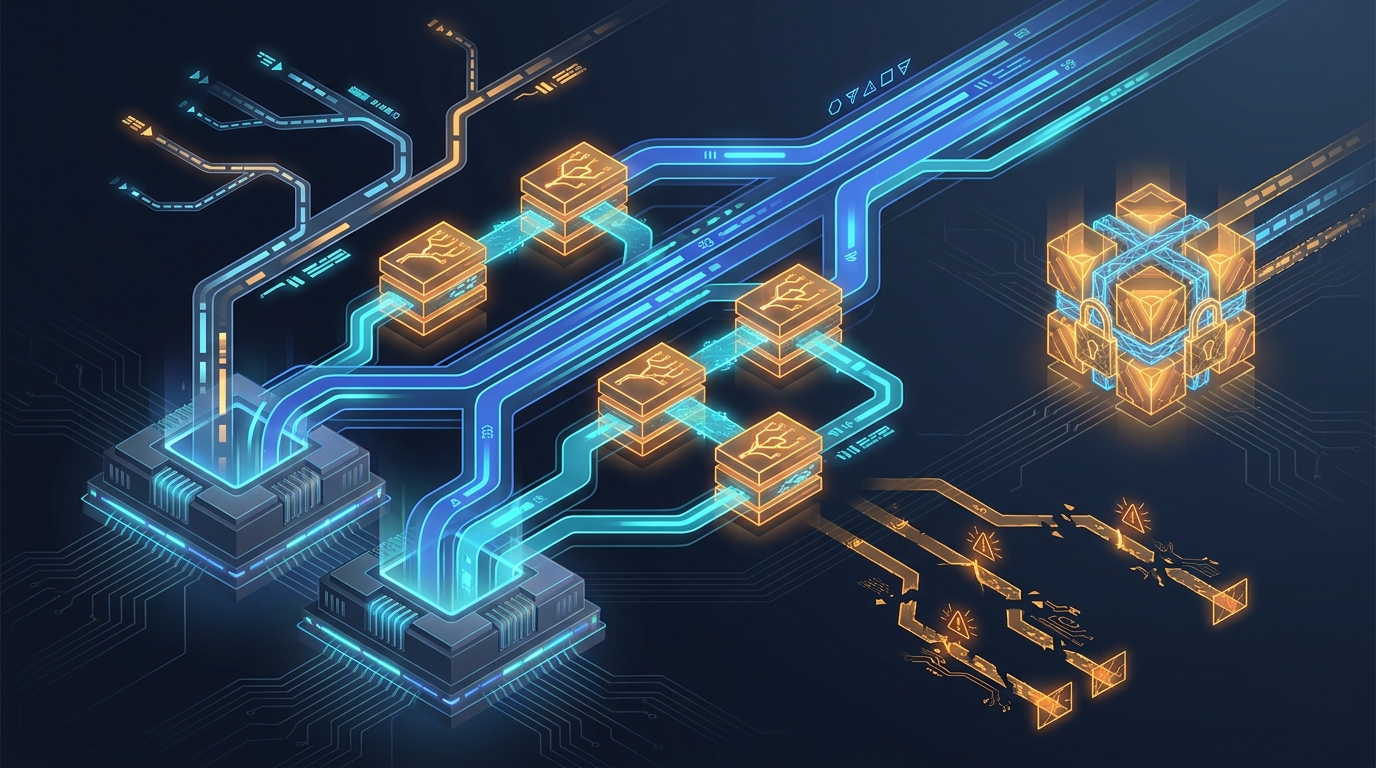
MegaCpp ships eight specialist networks behind one router. On NVIDIA we do not
run them under one sharding strategy. The base trunk and the dense specialists
stay on Megatron-CoreQuick term guideMegatron CoreThe NVIDIA framework surface MegaCpp ports into through narrow adapters, layer specs, and runtime ownership bridges.GroundingAbout: Porting to Megatron friction About: Nemotron-style recipe as pure Megatron CLI Example: Mamba3 TP mixer sample DistributedDataParallel plus the MegatronQuick term guideMegatronWhy lifting a hybrid attention/Mamba/MoE stack into Megatron-Core is a multi-adapter exercise: base config mapping, layer specs, mixer protocol, and…GroundingPorting To Megatron-Core Is Harder Than It Looks What Megatron Can and Cannot Split
DistributedOptimizer; the wide MoEQuick term guideMoEToken Choice vs Expert Choice, null-expert debugging, gating stability, and the production routing decisions behind the MegaCpp SLM Ensemble.GroundingThe MoE Routing We Actually Shipped Sequence, Context, and Expert Splits in the Hybrid Stack specialists and any LoRA-adapted heads move
to PyTorch FSDP2Quick term guideFSDP2PyTorch's Fully Sharded Data Parallel v2 wrapper API. On CUDA it shards parameters, gradients, and optimizer state across the data-parallel group; in the TPU/XLA posts here it is usually a memory-goal analogy, not the actual eager wrapper mechanism.GroundingAbout: FSDP2 on XLA TPU History: FSDP2 pain and payoff Example: FSDP sharding sample via fully_shard. This post is the NVIDIA-specific story:
which lane owns which parameters, how we size buckets on H200Quick term guideH200NVIDIA's Hopper H200 GPU platform, typically discussed here as an 8-GPU training node with large HBM capacity and NVLink-connected ranks.GroundingAbout: training on 8x H200 Reference: H200 memory geometry Reference: training speed anatomy on H200 and GB10Quick term guideGB10Consumer Grace Blackwell GB10 / DGX Spark bring-up lane used to separate driver-visible gates, patched cubin signals, and real execution proof.GroundingAbout: GB10 Stack Parity for MegaCpp: Torch 2.13 cu132, GCC 15, CUDA 13.2, and the Nightly Constraint About: GB10 tensor-path proof summary History: Training the MegaCpp SLM Ensemble on GB10: a Grace Blackwell war story, the
freeze plan we ship for the eight specialists, and the failure modes that
forced us to stop pretending one wrapper was enough.
Reader-first version: MegatronQuick term guideMegatronWhy lifting a hybrid attention/Mamba/MoE stack into Megatron-Core is a multi-adapter exercise: base config mapping, layer specs, mixer protocol, and…GroundingPorting To Megatron-Core Is Harder Than It Looks What Megatron Can and Cannot Split DDP is the dense-trunk ownership lane, FSDP2Quick term guideFSDP2PyTorch's Fully Sharded Data Parallel v2 wrapper API. On CUDA it shards parameters, gradients, and optimizer state across the data-parallel group; in the TPU/XLA posts here it is usually a memory-goal analogy, not the actual eager wrapper mechanism.GroundingAbout: FSDP2 on XLA TPU History: FSDP2 pain and payoff Example: FSDP sharding sample is the shard-the-specialist lane, and the hard rule is one wrapper per specialist, never both. The quickest checked-in decoder is FSDP sharding sample for rank-local memory ownership, FSDP2 plus LoRA sync sample for the late-adapter sync hazard, FSDP2 local-shard optimizer sample for the local-row optimizer view, and 3D parallelism sample for where this split sits inside TPQuick term guideTPTensor parallelism splits each linear's weights (QKV, O, MLP gate/up/down) across GPUs. On 8× H200 with TP=8 each GPU owns 1/8 of every matmul's columns or rows, so one big matmul becomes 8 smaller ones that all-reduce at the layer boundary. Cost: one all-reduce per attention and per MLP — heavy bandwidth, so TP is usually bound to a single NVLink/NVSwitch island (1 node of up to 8 GPUs). Embeddings, layernorms, and optimizer state stay replicated across the TP GPUs. Use TP when a single layer's weights don't fit on one GPU, not to scale past one node.GroundingAbout: parallelism map overview Example: TP partition-shape sample Reference: tensor parallel and sharding, PPQuick term guidePPPipeline parallelism cuts the model by depth — each GPU gets a contiguous range of layers. 32 transformer blocks on 8× H200 with PP=8 puts 4 layers on each GPU. Weights and optimizer state live only on the GPU owning that stage; activations flow GPU0→GPU1→... forward and back on the reverse pass. Cost: a pipeline bubble of roughly 1/microbatches — you need many microbatches per step to amortize. Use PP to scale past a single NVLink island across nodes, because what crosses the wire is tiny stage-boundary activations, not full tensors.GroundingAbout: parallelism map overview Example: pipeline parallel sample Example: pipeline activation sample, and EP.
If the hybrid family legend is the missing piece, open Hybrid block taxonomy sample, Hybrid pattern sample, and NAM56R Megatron plan sample before reading the wrapper details.
Why MegaCpp cares about this
Two facts dictate the design. First, the production training stack inherits a MegatronQuick term guideMegatronWhy lifting a hybrid attention/Mamba/MoE stack into Megatron-Core is a multi-adapter exercise: base config mapping, layer specs, mixer protocol, and…GroundingPorting To Megatron-Core Is Harder Than It Looks What Megatron Can and Cannot Split-style layout almost verbatim, which means TPQuick term guideTPTensor parallelism splits each linear's weights (QKV, O, MLP gate/up/down) across GPUs. On 8× H200 with TP=8 each GPU owns 1/8 of every matmul's columns or rows, so one big matmul becomes 8 smaller ones that all-reduce at the layer boundary. Cost: one all-reduce per attention and per MLP — heavy bandwidth, so TP is usually bound to a single NVLink/NVSwitch island (1 node of up to 8 GPUs). Embeddings, layernorms, and optimizer state stay replicated across the TP GPUs. Use TP when a single layer's weights don't fit on one GPU, not to scale past one node.GroundingAbout: parallelism map overview Example: TP partition-shape sample Reference: tensor parallel and sharding, PPQuick term guidePPPipeline parallelism cuts the model by depth — each GPU gets a contiguous range of layers. 32 transformer blocks on 8× H200 with PP=8 puts 4 layers on each GPU. Weights and optimizer state live only on the GPU owning that stage; activations flow GPU0→GPU1→... forward and back on the reverse pass. Cost: a pipeline bubble of roughly 1/microbatches — you need many microbatches per step to amortize. Use PP to scale past a single NVLink island across nodes, because what crosses the wire is tiny stage-boundary activations, not full tensors.GroundingAbout: parallelism map overview Example: pipeline parallel sample Example: pipeline activation sample, EPQuick term guideEPExpert parallelism partitions MoE experts across GPUs — 64 experts on 8× H200 with EP=8 means each GPU owns the full weights of 8 experts. Each token routes to its chosen expert via all-to-all (to the GPU holding that expert), the FFN runs there, then all-to-all sends outputs back. Cost: two all-to-alls per MoE layer plus load imbalance when hot experts overload their owner. Attention, embeddings, and shared dense weights stay replicated across the EP dimension. Use EP when expert weights dominate total model size.GroundingAbout: parallelism map overview Example: expert-parallel routing sample Reference: expert parallel and MoE sharding, and CPQuick term guideCPContext parallelism splits the sequence itself along the token axis. On 8× H200 with a 128K-token sample and CP=8 each GPU processes 16K local tokens; during attention the GPUs ring-exchange KV chunks so every one still sees the full past. Cost: a ring of KV sends that scales with sequence length — cheap on NVLink, expensive across nodes. Weights replicate on every CP GPU; only activations and the KV cache shard along sequence. Use CP when the sequence is too long for one GPU's KV cache, not to reduce weight memory — that's TP or FSDP's job.GroundingAbout: parallelism map overview Example: chunk boundary remap sample Reference: context parallel and sequence parallel already sit underneath MegatronQuick term guideMegatronWhy lifting a hybrid attention/Mamba/MoE stack into Megatron-Core is a multi-adapter exercise: base config mapping, layer specs, mixer protocol, and…GroundingPorting To Megatron-Core Is Harder Than It Looks What Megatron Can and Cannot Split DDP plus the distributed optimizer. That code path is the validated dense lane on H200Quick term guideH200NVIDIA's Hopper H200 GPU platform, typically discussed here as an 8-GPU training node with large HBM capacity and NVLink-connected ranks.GroundingAbout: training on 8x H200 Reference: H200 memory geometry Reference: training speed anatomy on H200 and the only lane that keeps TensorParallel Muon in its natural shape. Second, several specialists do not match that mold. Wide MoEQuick term guideMoEToken Choice vs Expert Choice, null-expert debugging, gating stability, and the production routing decisions behind the MegaCpp SLM Ensemble.GroundingThe MoE Routing We Actually Shipped Sequence, Context, and Expert Splits in the Hybrid Stack specialists want shardable parameter ownership more than they want the dense-trunk optimizer path, and tiny LoRA adapters should not trigger pointless all-gathers.
That is why the wrapper choice is per specialist rather than per whole model.
MegatronQuick term guideMegatronWhy lifting a hybrid attention/Mamba/MoE stack into Megatron-Core is a multi-adapter exercise: base config mapping, layer specs, mixer protocol, and…GroundingPorting To Megatron-Core Is Harder Than It Looks What Megatron Can and Cannot Split DDP keeps dense local matrix geometry intact enough for the trunk
optimizer path. FSDP2Quick term guideFSDP2PyTorch's Fully Sharded Data Parallel v2 wrapper API. On CUDA it shards parameters, gradients, and optimizer state across the data-parallel group; in the TPU/XLA posts here it is usually a memory-goal analogy, not the actual eager wrapper mechanism.GroundingAbout: FSDP2 on XLA TPU History: FSDP2 pain and payoff Example: FSDP sharding sample makes the local shard plus DTensorQuick term guideDTensorPyTorch's mesh-backed distributed-tensor abstraction: one logical tensor with explicit shard or replica metadata across ranks.GroundingAbout: EP / PP / TP / CP / SP / DP overview Example: 3D parallelism sample Reference: FSDP2 on XLA TPU metadata the
authoritative view, which is better for parameter-heavy specialists. If that
ownership split is still fuzzy, the next local reads are
FSDP2 pain and payoff,
expert parallel and MoE sharding, and
what Megatron can and cannot split.
What we built in the public MegaCpp NVIDIA stack
The public-safe version of the contract is intentionally simple. MegatronQuick term guideMegatronWhy lifting a hybrid attention/Mamba/MoE stack into Megatron-Core is a multi-adapter exercise: base config mapping, layer specs, mixer protocol, and…GroundingPorting To Megatron-Core Is Harder Than It Looks What Megatron Can and Cannot Split DDP
owns the dense trunk. FSDP2Quick term guideFSDP2PyTorch's Fully Sharded Data Parallel v2 wrapper API. On CUDA it shards parameters, gradients, and optimizer state across the data-parallel group; in the TPU/XLA posts here it is usually a memory-goal analogy, not the actual eager wrapper mechanism.GroundingAbout: FSDP2 on XLA TPU History: FSDP2 pain and payoff Example: FSDP sharding sample owns the parameter-heavy specialists. Expert
parameters must stay on the expert-data-parallel route instead of silently
rejoining the dense data-parallel lane. Bottom-up wrapping matters on the FSDP2Quick term guideFSDP2PyTorch's Fully Sharded Data Parallel v2 wrapper API. On CUDA it shards parameters, gradients, and optimizer state across the data-parallel group; in the TPU/XLA posts here it is usually a memory-goal analogy, not the actual eager wrapper mechanism.GroundingAbout: FSDP2 on XLA TPU History: FSDP2 pain and payoff Example: FSDP sharding sample
side, and late-added LoRA tensors need explicit synchronization if they were
not present when fully_shard ran.
The checked-in samples ground those claims directly. FSDP sharding sample keeps shard-local memory accounting honest. FSDP2 plus LoRA sync sample keeps the late-LoRA rule explicit. FSDP2 local-shard optimizer sample is the shortest reminder that the optimizer still steps the shard it actually owns. Parallelism glossary sample and 3D parallelism sample keep the DDP-versus-FSDP2Quick term guideFSDP2PyTorch's Fully Sharded Data Parallel v2 wrapper API. On CUDA it shards parameters, gradients, and optimizer state across the data-parallel group; in the TPU/XLA posts here it is usually a memory-goal analogy, not the actual eager wrapper mechanism.GroundingAbout: FSDP2 on XLA TPU History: FSDP2 pain and payoff Example: FSDP sharding sample choice separate from TPQuick term guideTPTensor parallelism splits each linear's weights (QKV, O, MLP gate/up/down) across GPUs. On 8× H200 with TP=8 each GPU owns 1/8 of every matmul's columns or rows, so one big matmul becomes 8 smaller ones that all-reduce at the layer boundary. Cost: one all-reduce per attention and per MLP — heavy bandwidth, so TP is usually bound to a single NVLink/NVSwitch island (1 node of up to 8 GPUs). Embeddings, layernorms, and optimizer state stay replicated across the TP GPUs. Use TP when a single layer's weights don't fit on one GPU, not to scale past one node.GroundingAbout: parallelism map overview Example: TP partition-shape sample Reference: tensor parallel and sharding, PPQuick term guidePPPipeline parallelism cuts the model by depth — each GPU gets a contiguous range of layers. 32 transformer blocks on 8× H200 with PP=8 puts 4 layers on each GPU. Weights and optimizer state live only on the GPU owning that stage; activations flow GPU0→GPU1→... forward and back on the reverse pass. Cost: a pipeline bubble of roughly 1/microbatches — you need many microbatches per step to amortize. Use PP to scale past a single NVLink island across nodes, because what crosses the wire is tiny stage-boundary activations, not full tensors.GroundingAbout: parallelism map overview Example: pipeline parallel sample Example: pipeline activation sample, and EP.
The other seam readers should not hand-wave is DTensorQuick term guideDTensorPyTorch's mesh-backed distributed-tensor abstraction: one logical tensor with explicit shard or replica metadata across ranks.GroundingAbout: EP / PP / TP / CP / SP / DP overview Example: 3D parallelism sample Reference: FSDP2 on XLA TPU and DeviceMeshQuick term guideDeviceMeshPyTorch's named logical device grid for distributed placement. It says which ranks belong to each parallel axis before DTensor or FSDP2 sharding metadata is applied.GroundingAbout: EP / PP / TP / CP / SP / DP overview Example: 3D parallelism sample Reference: XLA SPMD sharding annotations.
Once a specialist is on FSDP2Quick term guideFSDP2PyTorch's Fully Sharded Data Parallel v2 wrapper API. On CUDA it shards parameters, gradients, and optimizer state across the data-parallel group; in the TPU/XLA posts here it is usually a memory-goal analogy, not the actual eager wrapper mechanism.GroundingAbout: FSDP2 on XLA TPU History: FSDP2 pain and payoff Example: FSDP sharding sample, helper code needs to know whether it is touching
a local shard or an explicitly materialized full view. That is why
Torch 2.12 journey and
Checkpoint format and resume keep coming
back to local-shard helpers. The wrapper split is not only about parameter
bytes either; Distributed memory notes
are the compact reminder that activations, NCCLQuick term guideNCCLNVIDIA's collective-communication library for all-reduce, all-gather, reduce-scatter, and point-to-point transport on CUDA multi-GPU lanes.GroundingAbout: NCCL and collective hangs Example: pipeline parallel sample Reference: training on 8x H200 buckets, and MoEQuick term guideMoEToken Choice vs Expert Choice, null-expert debugging, gating stability, and the production routing decisions behind the MegaCpp SLM Ensemble.GroundingThe MoE Routing We Actually Shipped Sequence, Context, and Expert Splits in the Hybrid Stack routing
buffers can still dominate a step after parameter sharding looks correct.
How it lands in MegaCpp
In production we consolidate around the contract rather than around wrapper internals. The dense-lane DDP defaults live in one place. Expert-param marking is a hard boot-time precondition instead of a best-effort walk. On the FSDP2Quick term guideFSDP2PyTorch's Fully Sharded Data Parallel v2 wrapper API. On CUDA it shards parameters, gradients, and optimizer state across the data-parallel group; in the TPU/XLA posts here it is usually a memory-goal analogy, not the actual eager wrapper mechanism.GroundingAbout: FSDP2 on XLA TPU History: FSDP2 pain and payoff Example: FSDP sharding sample side, the bottom-up wrap order and the LoRA ignored-parameter logic stay explicit because those are the two things downstream users most often get wrong.
The bucket-sizing policy also moves into configuration rather than hidden
implementation seams. We keep MegatronQuick term guideMegatronWhy lifting a hybrid attention/Mamba/MoE stack into Megatron-Core is a multi-adapter exercise: base config mapping, layer specs, mixer protocol, and…GroundingPorting To Megatron-Core Is Harder Than It Looks What Megatron Can and Cannot Split's max(40M, 1M * dp_world_size)
parameter-count rule and pin dense-lane gradient reduction to bf16. That is
why grad_reduce_in_fp32=False is a real policy choice instead of a cleanup
flag: once the dense reduction surface is on the order of 5.1B local
parameters, switching the same buffer from bf16 to fp32 costs about 9.5 GB
of extra HBM.
The same logic explains the GB10Quick term guideGB10Consumer Grace Blackwell GB10 / DGX Spark bring-up lane used to separate driver-visible gates, patched cubin signals, and real execution proof.GroundingAbout: GB10 Stack Parity for MegaCpp: Torch 2.13 cu132, GCC 15, CUDA 13.2, and the Nightly Constraint About: GB10 tensor-path proof summary History: Training the MegaCpp SLM Ensemble on GB10: a Grace Blackwell war story carve-out. On H200Quick term guideH200NVIDIA's Hopper H200 GPU platform, typically discussed here as an 8-GPU training node with large HBM capacity and NVLink-connected ranks.GroundingAbout: training on 8x H200 Reference: H200 memory geometry Reference: training speed anatomy on H200, the safe band is roughly
80-128 MB because larger buckets amortize NCCLQuick term guideNCCLNVIDIA's collective-communication library for all-reduce, all-gather, reduce-scatter, and point-to-point transport on CUDA multi-GPU lanes.GroundingAbout: NCCL and collective hangs Example: pipeline parallel sample Reference: training on 8x H200 launch overhead without
crowding out the rest of the step. On GB10Quick term guideGB10Consumer Grace Blackwell GB10 / DGX Spark bring-up lane used to separate driver-visible gates, patched cubin signals, and real execution proof.GroundingAbout: GB10 Stack Parity for MegaCpp: Torch 2.13 cu132, GCC 15, CUDA 13.2, and the Nightly Constraint About: GB10 tensor-path proof summary History: Training the MegaCpp SLM Ensemble on GB10: a Grace Blackwell war story, the unified-memory path punishes
large pinned buffers, so we cap the bucket at 64 MB and stop pretending the
H200Quick term guideH200NVIDIA's Hopper H200 GPU platform, typically discussed here as an 8-GPU training node with large HBM capacity and NVLink-connected ranks.GroundingAbout: training on 8x H200 Reference: H200 memory geometry Reference: training speed anatomy on H200 setting transports cleanly to a tighter memory system. If you want the
transport-side continuation, read this together with
NCCL and collective hangs.
What we drop in the NVIDIA package is the standalone XLA sharding lane. The TPU-side analogue is documented separately in ZeRO-3-shaped sharding on the XLA backend.
Ablations and what we kept
The freeze plan for the eight specialists is dull but load-bearing. Frozen parameters stay visible to the optimizer scan. We freeze in place and never delete them from the module tree just to make a wrapper look cleaner.
Bucket sizing is the other boring rule worth keeping. On H200Quick term guideH200NVIDIA's Hopper H200 GPU platform, typically discussed here as an 8-GPU training node with large HBM capacity and NVLink-connected ranks.GroundingAbout: training on 8x H200 Reference: H200 memory geometry Reference: training speed anatomy on H200 we tested
25 MB, 80 MB, 128 MB, and 256 MB. 80 MB and 128 MB were inside the
safe band, 25 MB paid too much NCCLQuick term guideNCCLNVIDIA's collective-communication library for all-reduce, all-gather, reduce-scatter, and point-to-point transport on CUDA multi-GPU lanes.GroundingAbout: NCCL and collective hangs Example: pipeline parallel sample Reference: training on 8x H200 overhead, and 256 MB started to hit
param-gather stalls once EPQuick term guideEPExpert parallelism partitions MoE experts across GPUs — 64 experts on 8× H200 with EP=8 means each GPU owns the full weights of 8 experts. Each token routes to its chosen expert via all-to-all (to the GPU holding that expert), the FFN runs there, then all-to-all sends outputs back. Cost: two all-to-alls per MoE layer plus load imbalance when hot experts overload their owner. Attention, embeddings, and shared dense weights stay replicated across the EP dimension. Use EP when expert weights dominate total model size.GroundingAbout: parallelism map overview Example: expert-parallel routing sample Reference: expert parallel and MoE sharding narrowed the DPQuick term guideDPData parallelism replicates the whole model on every GPU and each GPU trains on a different slice of the batch (global_bs = local_bs × DP). After backward, gradients all-reduce across the DP GPUs so every replica ends the step with identical weights. Cost: one all-reduce per step sized to the full model — on 8× H200 a 70B model is about 140 GB of gradient traffic every step. Plain DDP keeps the whole model + optimizer state on every GPU; FSDP / ZeRO-3 shards them across the DP mesh to recover that memory. Use DP to raise throughput, not to fit a bigger model — that's FSDP's job.GroundingAbout: parallelism map overview Example: FSDP sharding sample group. On GB10Quick term guideGB10Consumer Grace Blackwell GB10 / DGX Spark bring-up lane used to separate driver-visible gates, patched cubin signals, and real execution proof.GroundingAbout: GB10 Stack Parity for MegaCpp: Torch 2.13 cu132, GCC 15, CUDA 13.2, and the Nightly Constraint About: GB10 tensor-path proof summary History: Training the MegaCpp SLM Ensemble on GB10: a Grace Blackwell war story the picture flips,
so the 64 MB cap acts as flow control rather than as a magic correctness
threshold.
What we tried and dropped:
- A single-wrapper world where everything ran under FSDP2Quick term guideFSDP2PyTorch's Fully Sharded Data Parallel v2 wrapper API. On CUDA it shards parameters, gradients, and optimizer state across the data-parallel group; in the TPU/XLA posts here it is usually a memory-goal analogy, not the actual eager wrapper mechanism.GroundingAbout: FSDP2 on XLA TPU History: FSDP2 pain and payoff Example: FSDP sharding sample. It simplified the story and lost too much on the dense optimizer path.
- Disabling
overlap_param_gather. It made the loud step louder. grad_reduce_in_fp32=Truefor "safety". It cost memory and bandwidth without moving a loss curve we could measure.- Hand-rolled prefetch scheduling in front of FSDP2Quick term guideFSDP2PyTorch's Fully Sharded Data Parallel v2 wrapper API. On CUDA it shards parameters, gradients, and optimizer state across the data-parallel group; in the TPU/XLA posts here it is usually a memory-goal analogy, not the actual eager wrapper mechanism.GroundingAbout: FSDP2 on XLA TPU History: FSDP2 pain and payoff Example: FSDP sharding sample. The shipped prefetch-depth knob was better than our custom version.
The failure modes that taught us the rules:
- An H200Quick term guideH200NVIDIA's Hopper H200 GPU platform, typically discussed here as an 8-GPU training node with large HBM capacity and NVLink-connected ranks.GroundingAbout: training on 8x H200 Reference: H200 memory geometry Reference: training speed anatomy on H200 first-forward hang when TPQuick term guideTPTensor parallelism splits each linear's weights (QKV, O, MLP gate/up/down) across GPUs. On 8× H200 with TP=8 each GPU owns 1/8 of every matmul's columns or rows, so one big matmul becomes 8 smaller ones that all-reduce at the layer boundary. Cost: one all-reduce per attention and per MLP — heavy bandwidth, so TP is usually bound to a single NVLink/NVSwitch island (1 node of up to 8 GPUs). Embeddings, layernorms, and optimizer state stay replicated across the TP GPUs. Use TP when a single layer's weights don't fit on one GPU, not to scale past one node.GroundingAbout: parallelism map overview Example: TP partition-shape sample Reference: tensor parallel and sharding-owned attentionQuick term guideAttentionThe token-mixing path that turns Q/K/V style projections into context-aware activations. On MLA pages here it refers to the concrete attention module boundary, not the A/M/E/R block-family shorthand.GroundingAbout: fused MLA on NVIDIA Reference: public-safe MLA integration patterns Reference: shared MLA adapter boundaries and MLP weights were gathered into one eager FSDP unshard. Fix: keep TP-owned block params out of the FSDP block wrappers on the validated TP lanes.
- A nested-root wrap deadlock in torch 2.12 nightlies. Fix: keep the root state explicit while real params live on child wrappers, and manually synchronize the small unmanaged tail that stays outside the child-wrapped sets.
- Silent expert-grad routing to the dense process group when a module rename caused the expert-marker walk to miss the expert bank. Fix: treat expert marking as a hard assertion.
Production checklist
- One wrapper per specialist; never wrap the same module under both MegatronQuick term guideMegatronWhy lifting a hybrid attention/Mamba/MoE stack into Megatron-Core is a multi-adapter exercise: base config mapping, layer specs, mixer protocol, and…GroundingPorting To Megatron-Core Is Harder Than It Looks What Megatron Can and Cannot Split DDP and FSDP2.
- Mark expert parameters with
allreduce=Falsebefore constructing MegatronQuick term guideMegatronWhy lifting a hybrid attention/Mamba/MoE stack into Megatron-Core is a multi-adapter exercise: base config mapping, layer specs, mixer protocol, and…GroundingPorting To Megatron-Core Is Harder Than It Looks What Megatron Can and Cannot Split DDP; assert the count is non-zero on any MoE specialist. - Use bf16 gradient reduction; do not enable
grad_reduce_in_fp32without a measured loss-quality reason. - Set bucket size from the MegatronQuick term guideMegatronWhy lifting a hybrid attention/Mamba/MoE stack into Megatron-Core is a multi-adapter exercise: base config mapping, layer specs, mixer protocol, and…GroundingPorting To Megatron-Core Is Harder Than It Looks What Megatron Can and Cannot Split formula on H200Quick term guideH200NVIDIA's Hopper H200 GPU platform, typically discussed here as an 8-GPU training node with large HBM capacity and NVLink-connected ranks.GroundingAbout: training on 8x H200 Reference: H200 memory geometry Reference: training speed anatomy on H200; cap at
64 MBon GB10Quick term guideGB10Consumer Grace Blackwell GB10 / DGX Spark bring-up lane used to separate driver-visible gates, patched cubin signals, and real execution proof.GroundingAbout: GB10 Stack Parity for MegaCpp: Torch 2.13 cu132, GCC 15, CUDA 13.2, and the Nightly Constraint About: GB10 tensor-path proof summary History: Training the MegaCpp SLM Ensemble on GB10: a Grace Blackwell war story. - Pass LoRA params as
ignored_paramstofully_shardif injected pre-FSDP; otherwise install explicit sync hooks after injection. - Keep MegatronQuick term guideMegatronWhy lifting a hybrid attention/Mamba/MoE stack into Megatron-Core is a multi-adapter exercise: base config mapping, layer specs, mixer protocol, and…GroundingPorting To Megatron-Core Is Harder Than It Looks What Megatron Can and Cannot Split DDP construction and graph-capture boundaries stable; do not mix wrapper setup with later capture-time mutations.
- Wrap FSDP2Quick term guideFSDP2PyTorch's Fully Sharded Data Parallel v2 wrapper API. On CUDA it shards parameters, gradients, and optimizer state across the data-parallel group; in the TPU/XLA posts here it is usually a memory-goal analogy, not the actual eager wrapper mechanism.GroundingAbout: FSDP2 on XLA TPU History: FSDP2 pain and payoff Example: FSDP sharding sample bottom-up: blocks, then embeddings and heads, then auxiliaries, then root last.
- Prefer
reshard_after_forward=Trueby default; flip to integerNfor intra-node hybrid sharding only when DP is large. - Pin the NCCLQuick term guideNCCLNVIDIA's collective-communication library for all-reduce, all-gather, reduce-scatter, and point-to-point transport on CUDA multi-GPU lanes.GroundingAbout: NCCL and collective hangs Example: pipeline parallel sample Reference: training on 8x H200 algorithm per SKU rather than relying on autotune.
- Freeze in place; never delete parameters that the optimizer scan must see.
Specialist freeze and wrapper map
| Specialist | Wrapper | Frozen at specialist phase | Notes |
|---|---|---|---|
| Trunk + dense reasoning | Megatron DDP + DistributedOptimizer | embedding, lower trunk | allreduce=True, bf16 grad reduce |
| Wide MoE | FSDP2 + AdamW | embedding, routing head when off | allreduce=False on every expert param |
| LoRA-adapted reasoning | FSDP2 + ignored params | base linear, embedding | tiny adapters never enter the all-gather |
| MTP / scalar heads | FSDP2 root-level | none | wrapped after blocks, before root |
The contract that prevents the silent expert-grad bug:
def mark_expert_params_for_expert_group(model):
    for name, mod in model.named_modules():
        if mod.__class__.__name__ in {"FusedExpertBank", "ExpertMLP",
                                      "FusedMoEExpertBank"} or ".experts." in name:
            for p in mod.parameters(recurse=False):
                p.allreduce = False  # routes to expert-data-parallel group
Frequently asked questions
Why not run everything under FSDP2?+
Why does the dense Muon lane care about wrapper choice?+
DTensorQuick term guideDTensorPyTorch's mesh-backed distributed-tensor abstraction: one logical tensor with explicit shard or replica metadata across ranks. view that must be interpreted deliberately. That is why the trunk stays on MegatronQuick term guideMegatronWhy lifting a hybrid attention/Mamba/MoE stack into Megatron-Core is a multi-adapter exercise: base config mapping, layer specs, mixer protocol, and… DDP, while the FSDP2 local-shard Muon contract remains a specialist-side adapter: recover the local shard bounds first, then scale split metadata against the rows this rank actually owns. The short checked-in proof is FSDP2 local-shard optimizer sample, with Muon on Hopper and Blackwell and Distributed optimizer stress covering the optimizer-side details.What is the practical boundary between Megatron DDP and FSDP2 here?+
Why keep LoRA adapters out of FSDP2 sharding?+
fully_shard. If they are injected later, FSDP2 never saw them, so MegaCpp attaches explicit gradient sync hooks for those adapter tensors. The checked-in contract is FSDP2 plus LoRA sync sample.Where does the 9.5 GB bf16-versus-fp32 reduction number come from?+
5.1B × 2 bytes, which is roughly 9.5 GB of HBM.Why does GB10 cap bucket size at 64 MB?+
What does allreduce=False mean in this context?+
Why can a generic gradient helper not just all-reduce FSDP2 DTensor grads?+
DTensorQuick term guideDTensorPyTorch's mesh-backed distributed-tensor abstraction: one logical tensor with explicit shard or replica metadata across ranks. parameters and their grads for exactly that reason.Terms used in this article
Start here for quick definitions, then follow the linked posts for deeper context.
PyTorch's Fully Sharded Data Parallel v2 wrapper API. On CUDA it shards parameters, gradients, and optimizer state across the data-parallel group; in the TPU/XLA posts here it is usually a memory-goal analogy, not the actual eager wrapper mechanism.
The NVIDIA framework surface MegaCpp ports into through narrow adapters, layer specs, and runtime ownership bridges.
Consumer Grace Blackwell GB10 / DGX Spark bring-up lane used to separate driver-visible gates, patched cubin signals, and real execution proof.
PyTorch's mesh-backed distributed-tensor abstraction: one logical tensor with explicit shard or replica metadata across ranks.
Tensor parallelism splits each linear's weights (QKV, O, MLP gate/up/down) across GPUs. On 8× H200 with TP=8 each GPU owns 1/8 of every matmul's columns or rows, so one big matmul becomes 8 smaller ones that all-reduce at the layer boundary. Cost: one all-reduce per attention and per MLP — heavy bandwidth, so TP is usually bound to a single NVLink/NVSwitch island (1 node of up to 8 GPUs). Embeddings, layernorms, and optimizer state stay replicated across the TP GPUs. Use TP when a single layer's weights don't fit on one GPU, not to scale past one node.
Pipeline parallelism cuts the model by depth — each GPU gets a contiguous range of layers. 32 transformer blocks on 8× H200 with PP=8 puts 4 layers on each GPU. Weights and optimizer state live only on the GPU owning that stage; activations flow GPU0→GPU1→... forward and back on the reverse pass. Cost: a pipeline bubble of roughly 1/microbatches — you need many microbatches per step to amortize. Use PP to scale past a single NVLink island across nodes, because what crosses the wire is tiny stage-boundary activations, not full tensors.
NVIDIA's Hopper H200 GPU platform, typically discussed here as an 8-GPU training node with large HBM capacity and NVLink-connected ranks.
PyTorch's named logical device grid for distributed placement. It says which ranks belong to each parallel axis before DTensor or FSDP2 sharding metadata is applied.
A concrete MegaCpp hybrid family name whose meaning lives in the launch pattern, feature placement, and runtime constraints rather than in one marketing label.
Context parallelism splits the sequence itself along the token axis. On 8× H200 with a 128K-token sample and CP=8 each GPU processes 16K local tokens; during attention the GPUs ring-exchange KV chunks so every one still sees the full past. Cost: a ring of KV sends that scales with sequence length — cheap on NVLink, expensive across nodes. Weights replicate on every CP GPU; only activations and the KV cache shard along sequence. Use CP when the sequence is too long for one GPU's KV cache, not to reduce weight memory — that's TP or FSDP's job.
Expert parallelism partitions MoE experts across GPUs — 64 experts on 8× H200 with EP=8 means each GPU owns the full weights of 8 experts. Each token routes to its chosen expert via all-to-all (to the GPU holding that expert), the FFN runs there, then all-to-all sends outputs back. Cost: two all-to-alls per MoE layer plus load imbalance when hot experts overload their owner. Attention, embeddings, and shared dense weights stay replicated across the EP dimension. Use EP when expert weights dominate total model size.
Data parallelism replicates the whole model on every GPU and each GPU trains on a different slice of the batch (global_bs = local_bs × DP). After backward, gradients all-reduce across the DP GPUs so every replica ends the step with identical weights. Cost: one all-reduce per step sized to the full model — on 8× H200 a 70B model is about 140 GB of gradient traffic every step. Plain DDP keeps the whole model + optimizer state on every GPU; FSDP / ZeRO-3 shards them across the DP mesh to recover that memory. Use DP to raise throughput, not to fit a bigger model — that's FSDP's job.
Why lifting a hybrid attention/Mamba/MoE stack into Megatron-Core is a multi-adapter exercise: base config mapping, layer specs, mixer protocol, and…
NVIDIA's collective-communication library for all-reduce, all-gather, reduce-scatter, and point-to-point transport on CUDA multi-GPU lanes.
Token Choice vs Expert Choice, null-expert debugging, gating stability, and the production routing decisions behind the MegaCpp SLM Ensemble.
The token-mixing path that turns Q/K/V style projections into context-aware activations. On MLA pages here it refers to the concrete attention module boundary, not the A/M/E/R block-family shorthand.