A Memory-Budget Anatomy for One Specialist on H200:8
Line-by-line breakdown of weights, gradients, Muon+AdamW state, activations, KV cache, communication buffers, allocator overhead, and fragmentation for a single specialist trained on 8x H200, with the GB10 contrast.
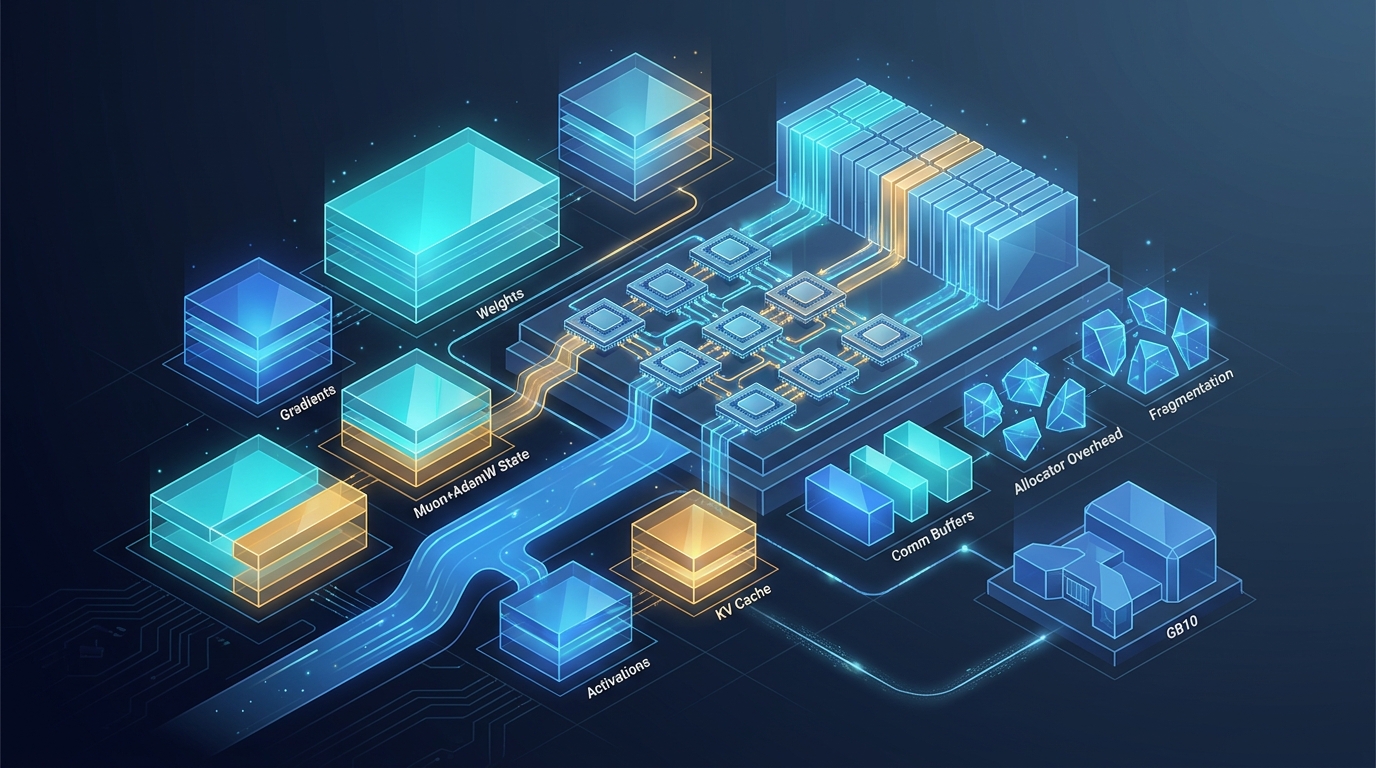
This system is an ensemble of specialist SLMs trained independently. The unit of capacity planning is therefore not "the full ensemble" but "one specialist on one 8x H200Quick term guideH200NVIDIA's Hopper H200 GPU platform, typically discussed here as an 8-GPU training node with large HBM capacity and NVLink-connected ranks.GroundingAbout: training on 8x H200 Reference: H200 memory geometry Reference: training speed anatomy on H200 node". This post walks that unit's per-device HBM budget line by line: weights, gradients, Muon+AdamW state, activations under the current per-block recompute policy, KV cacheQuick term guideKV CacheThe stored attention keys and values from earlier tokens so decode can reuse prior context instead of recomputing the full prefix every step.GroundingAbout: KV cache and paged attention Example: Dense FA4 KV-cache decode sample Reference: inference serving stack during eval and serving, communication scratch, allocator overhead, and the fragmentation tail. Numbers are anchored in an analytical memory estimator and repeated H200Quick term guideH200NVIDIA's Hopper H200 GPU platform, typically discussed here as an 8-GPU training node with large HBM capacity and NVLink-connected ranks.GroundingAbout: training on 8x H200 Reference: H200 memory geometry Reference: training speed anatomy on H200/GB10Quick term guideGB10Consumer Grace Blackwell GB10 / DGX Spark bring-up lane used to separate driver-visible gates, patched cubin signals, and real execution proof.GroundingAbout: GB10 Stack Parity for MegaCpp: Torch 2.13 cu132, GCC 15, CUDA 13.2, and the Nightly Constraint About: GB10 tensor-path proof summary History: Training the MegaCpp SLM Ensemble on GB10: a Grace Blackwell war story calibration runs.
Why this matters
Each specialist is roughly the depth-52/56 hybrid shape with attentionQuick term guideAttentionThe token-mixing path that turns Q/K/V style projections into context-aware activations. On MLA pages here it refers to the concrete attention module boundary, not the A/M/E/R block-family shorthand.GroundingAbout: fused MLA on NVIDIA Reference: shared MLA adapter boundaries Reference: public-safe MLA integration patterns, Mamba-3, and MoEQuick term guideMoEToken Choice vs Expert Choice, null-expert debugging, gating stability, and the production routing decisions behind the MegaCpp SLM Ensemble.GroundingThe MoE Routing We Actually Shipped Sequence, Context, and Expert Splits in the Hybrid Stack blocks interleaved. An 8x H200Quick term guideH200NVIDIA's Hopper H200 GPU platform, typically discussed here as an 8-GPU training node with large HBM capacity and NVLink-connected ranks.GroundingAbout: training on 8x H200 Reference: H200 memory geometry Reference: training speed anatomy on H200 node has 141 GB HBM3e per device and a fast NVLink fabric; GB10Quick term guideGB10Consumer Grace Blackwell GB10 / DGX Spark bring-up lane used to separate driver-visible gates, patched cubin signals, and real execution proof.GroundingAbout: GB10 Stack Parity for MegaCpp: Torch 2.13 cu132, GCC 15, CUDA 13.2, and the Nightly Constraint About: GB10 tensor-path proof summary History: Training the MegaCpp SLM Ensemble on GB10: a Grace Blackwell war story has 128 GB unified memory and a slower interconnect. The same definition runs differently on the two, mostly in the activation and communication columns. Every recipe change (a new MoEQuick term guideMoEToken Choice vs Expert Choice, null-expert debugging, gating stability, and the production routing decisions behind the MegaCpp SLM Ensemble.GroundingThe MoE Routing We Actually Shipped Sequence, Context, and Expert Splits in the Hybrid Stack expert count, a different AdamW/Muon split, FP16 to FP8Quick term guideFP8Eight-bit floating-point training and inference formats used to trade precision for throughput and memory on recent accelerator lanes.GroundingAbout: precision recipe: FP16, BF16, FP8, NVFP4 History: FP8 rollout notes Reference: Megatron FLCE on Hopper weights) reshuffles which line dominates, so the budget has to be legible. The pre-flight estimator exists so a launch does not spend most of an hour compiling only to OOM at step 0.
What the estimator models
The memory estimator is the per-device model. Three things matter about its shape.
First, the hardware table. It carries usable HBM per chip, for example H200Quick term guideH200NVIDIA's Hopper H200 GPU platform, typically discussed here as an 8-GPU training node with large HBM capacity and NVLink-connected ranks.GroundingAbout: training on 8x H200 Reference: H200 memory geometry Reference: training speed anatomy on H200 at 141.0 GB and GB10Quick term guideGB10Consumer Grace Blackwell GB10 / DGX Spark bring-up lane used to separate driver-visible gates, patched cubin signals, and real execution proof.GroundingAbout: GB10 Stack Parity for MegaCpp: Torch 2.13 cu132, GCC 15, CUDA 13.2, and the Nightly Constraint About: GB10 tensor-path proof summary History: Training the MegaCpp SLM Ensemble on GB10: a Grace Blackwell war story at 128.0 GB unified, and it tracks dtype byte widths such as bf16 (2), fp8_e4m3 (1), and nvfp4Quick term guideNVFP4NVIDIA's four-bit floating-point inference/training format family used when the lane can tolerate more aggressive quantization than FP8.GroundingAbout: precision recipe: FP16, BF16, FP8, NVFP4 Reference: NVFP4 inference (0.5). That lookup is what turns "drop weights to FP8Quick term guideFP8Eight-bit floating-point training and inference formats used to trade precision for throughput and memory on recent accelerator lanes.GroundingAbout: precision recipe: FP16, BF16, FP8, NVFP4 History: FP8 rollout notes Reference: Megatron FLCE on Hopper" into a real number.
Second, the breakdown. The schema separates replicated parameters such as embeddings, norms, and routers; TPQuick term guideTPTensor parallelism splits each linear's weights (QKV, O, MLP gate/up/down) across GPUs. On 8× H200 with TP=8 each GPU owns 1/8 of every matmul's columns or rows, so one big matmul becomes 8 smaller ones that all-reduce at the layer boundary. Cost: one all-reduce per attention and per MLP — heavy bandwidth, so TP is usually bound to a single NVLink/NVSwitch island (1 node of up to 8 GPUs). Embeddings, layernorms, and optimizer state stay replicated across the TP GPUs. Use TP when a single layer's weights don't fit on one GPU, not to scale past one node.GroundingAbout: parallelism map overview Example: TP partition-shape sample Reference: tensor parallel and sharding-sharded parameters such as Q/K/V/O, MLP, and Mamba projections; EPQuick term guideEPExpert parallelism partitions MoE experts across GPUs — 64 experts on 8× H200 with EP=8 means each GPU owns the full weights of 8 experts. Each token routes to its chosen expert via all-to-all (to the GPU holding that expert), the FFN runs there, then all-to-all sends outputs back. Cost: two all-to-alls per MoE layer plus load imbalance when hot experts overload their owner. Attention, embeddings, and shared dense weights stay replicated across the EP dimension. Use EP when expert weights dominate total model size.GroundingAbout: parallelism map overview Example: expert-parallel routing sample Reference: expert parallel and MoE sharding-sharded MoEQuick term guideMoEToken Choice vs Expert Choice, null-expert debugging, gating stability, and the production routing decisions behind the MegaCpp SLM Ensemble.GroundingThe MoE Routing We Actually Shipped Sequence, Context, and Expert Splits in the Hybrid Stack expert banks; optional feature families such as Engram, DSAQuick term guideDSADeepSeek Sparse Attention: a sparse-attention lane where routing and masking logic must stay faithful to the score path without breaking runtime constraints such as CUDA graph capture.GroundingAbout: DSA and CUDA graph safety History: DSA index cache patch Example: DSA CUDA graph safety sample, mHC, MTP, NCP, n-gram hash, structure embeddings, and tree FFN; plus gradients, Muon state, AdamW state, activations, MoEQuick term guideMoEToken Choice vs Expert Choice, null-expert debugging, gating stability, and the production routing decisions behind the MegaCpp SLM Ensemble.GroundingThe MoE Routing We Actually Shipped Sequence, Context, and Expert Splits in the Hybrid Stack routing, feature activations, overhead, and runtime reserve. Below 10% headroom the estimator emits a tight-fit warning because compile peaks eat what looks like comfortable margin.
Third, the categorisation. Every parameter group is tagged with a shard type such as replicated, TPQuick term guideTPTensor parallelism splits each linear's weights (QKV, O, MLP gate/up/down) across GPUs. On 8× H200 with TP=8 each GPU owns 1/8 of every matmul's columns or rows, so one big matmul becomes 8 smaller ones that all-reduce at the layer boundary. Cost: one all-reduce per attention and per MLP — heavy bandwidth, so TP is usually bound to a single NVLink/NVSwitch island (1 node of up to 8 GPUs). Embeddings, layernorms, and optimizer state stay replicated across the TP GPUs. Use TP when a single layer's weights don't fit on one GPU, not to scale past one node.GroundingAbout: parallelism map overview Example: TP partition-shape sample Reference: tensor parallel and sharding-sharded, EPQuick term guideEPExpert parallelism partitions MoE experts across GPUs — 64 experts on 8× H200 with EP=8 means each GPU owns the full weights of 8 experts. Each token routes to its chosen expert via all-to-all (to the GPU holding that expert), the FFN runs there, then all-to-all sends outputs back. Cost: two all-to-alls per MoE layer plus load imbalance when hot experts overload their owner. Attention, embeddings, and shared dense weights stay replicated across the EP dimension. Use EP when expert weights dominate total model size.GroundingAbout: parallelism map overview Example: expert-parallel routing sample Reference: expert parallel and MoE sharding-sharded, or CPU-only, and an optimizer type such as Muon or AdamW. Shard type drives the per-device divisor; optimizer type drives the per-parameter byte multiplier. That tagging separates the Muon column from the AdamW column instead of producing one opaque optimizer number.
Per-line budget for one specialist on one H200Quick term guideH200NVIDIA's Hopper H200 GPU platform, typically discussed here as an 8-GPU training node with large HBM capacity and NVLink-connected ranks.GroundingAbout: training on 8x H200 Reference: H200 memory geometry Reference: training speed anatomy on H200 device. Ranges are illustrative; exact values depend on the preset.
Weights. For the depth-52 hybrid at our standard width, the per-device parameter footprint after TPQuick term guideTPTensor parallelism splits each linear's weights (QKV, O, MLP gate/up/down) across GPUs. On 8× H200 with TP=8 each GPU owns 1/8 of every matmul's columns or rows, so one big matmul becomes 8 smaller ones that all-reduce at the layer boundary. Cost: one all-reduce per attention and per MLP — heavy bandwidth, so TP is usually bound to a single NVLink/NVSwitch island (1 node of up to 8 GPUs). Embeddings, layernorms, and optimizer state stay replicated across the TP GPUs. Use TP when a single layer's weights don't fit on one GPU, not to scale past one node.GroundingAbout: parallelism map overview Example: TP partition-shape sample Reference: tensor parallel and sharding=2 plus EPQuick term guideEPExpert parallelism partitions MoE experts across GPUs — 64 experts on 8× H200 with EP=8 means each GPU owns the full weights of 8 experts. Each token routes to its chosen expert via all-to-all (to the GPU holding that expert), the FFN runs there, then all-to-all sends outputs back. Cost: two all-to-alls per MoE layer plus load imbalance when hot experts overload their owner. Attention, embeddings, and shared dense weights stay replicated across the EP dimension. Use EP when expert weights dominate total model size.GroundingAbout: parallelism map overview Example: expert-parallel routing sample Reference: expert parallel and MoE sharding=2 sits in the low tens of GB at bf16. Routers, embeddings, and norms stay replicated; attentionQuick term guideAttentionThe token-mixing path that turns Q/K/V style projections into context-aware activations. On MLA pages here it refers to the concrete attention module boundary, not the A/M/E/R block-family shorthand.GroundingAbout: fused MLA on NVIDIA Reference: shared MLA adapter boundaries Reference: public-safe MLA integration patterns Q/K/V/O, MLP, Mamba projections, and shared experts are TPQuick term guideTPTensor parallelism splits each linear's weights (QKV, O, MLP gate/up/down) across GPUs. On 8× H200 with TP=8 each GPU owns 1/8 of every matmul's columns or rows, so one big matmul becomes 8 smaller ones that all-reduce at the layer boundary. Cost: one all-reduce per attention and per MLP — heavy bandwidth, so TP is usually bound to a single NVLink/NVSwitch island (1 node of up to 8 GPUs). Embeddings, layernorms, and optimizer state stay replicated across the TP GPUs. Use TP when a single layer's weights don't fit on one GPU, not to scale past one node.GroundingAbout: parallelism map overview Example: TP partition-shape sample Reference: tensor parallel and sharding-sharded; routed experts are EPQuick term guideEPExpert parallelism partitions MoE experts across GPUs — 64 experts on 8× H200 with EP=8 means each GPU owns the full weights of 8 experts. Each token routes to its chosen expert via all-to-all (to the GPU holding that expert), the FFN runs there, then all-to-all sends outputs back. Cost: two all-to-alls per MoE layer plus load imbalance when hot experts overload their owner. Attention, embeddings, and shared dense weights stay replicated across the EP dimension. Use EP when expert weights dominate total model size.GroundingAbout: parallelism map overview Example: expert-parallel routing sample Reference: expert parallel and MoE sharding-sharded. wte and lm_head are each vocab_size * D and replicated. Dropping weights from BF16 to FP8Quick term guideFP8Eight-bit floating-point training and inference formats used to trade precision for throughput and memory on recent accelerator lanes.GroundingAbout: precision recipe: FP16, BF16, FP8, NVFP4 History: FP8 rollout notes Reference: Megatron FLCE on Hopper with --fp8 halves this column for the matrices torchao wraps; fp8_all_gather also halves collective bandwidth. NVFP4Quick term guideNVFP4NVIDIA's four-bit floating-point inference/training format family used when the lane can tolerate more aggressive quantization than FP8.GroundingAbout: precision recipe: FP16, BF16, FP8, NVFP4 Reference: NVFP4 inference weights would cut another 2x but we do not train weights in NVFP4Quick term guideNVFP4NVIDIA's four-bit floating-point inference/training format family used when the lane can tolerate more aggressive quantization than FP8.GroundingAbout: precision recipe: FP16, BF16, FP8, NVFP4 Reference: NVFP4 inference - it is the activation/compute path on GB10Quick term guideGB10Consumer Grace Blackwell GB10 / DGX Spark bring-up lane used to separate driver-visible gates, patched cubin signals, and real execution proof.GroundingAbout: GB10 Stack Parity for MegaCpp: Torch 2.13 cu132, GCC 15, CUDA 13.2, and the Nightly Constraint About: GB10 tensor-path proof summary History: Training the MegaCpp SLM Ensemble on GB10: a Grace Blackwell war story only.
Gradients. The sharded gradient term uses the same TPQuick term guideTPTensor parallelism splits each linear's weights (QKV, O, MLP gate/up/down) across GPUs. On 8× H200 with TP=8 each GPU owns 1/8 of every matmul's columns or rows, so one big matmul becomes 8 smaller ones that all-reduce at the layer boundary. Cost: one all-reduce per attention and per MLP — heavy bandwidth, so TP is usually bound to a single NVLink/NVSwitch island (1 node of up to 8 GPUs). Embeddings, layernorms, and optimizer state stay replicated across the TP GPUs. Use TP when a single layer's weights don't fit on one GPU, not to scale past one node.GroundingAbout: parallelism map overview Example: TP partition-shape sample Reference: tensor parallel and sharding and EPQuick term guideEPExpert parallelism partitions MoE experts across GPUs — 64 experts on 8× H200 with EP=8 means each GPU owns the full weights of 8 experts. Each token routes to its chosen expert via all-to-all (to the GPU holding that expert), the FFN runs there, then all-to-all sends outputs back. Cost: two all-to-alls per MoE layer plus load imbalance when hot experts overload their owner. Attention, embeddings, and shared dense weights stay replicated across the EP dimension. Use EP when expert weights dominate total model size.GroundingAbout: parallelism map overview Example: expert-parallel routing sample Reference: expert parallel and MoE sharding divisors as weights, plus a data-parallel divisor when FSDP2Quick term guideFSDP2PyTorch's Fully Sharded Data Parallel v2 wrapper API. On CUDA it shards parameters, gradients, and optimizer state across the data-parallel group; in the TPU/XLA posts here it is usually a memory-goal analogy, not the actual eager wrapper mechanism.GroundingAbout: FSDP2 on XLA TPU History: FSDP2 pain and payoff Example: FSDP sharding sample is on for non-replicated tensors. On CUDAQuick term guideCUDANVIDIA's GPU programming stack: compiler, runtime, driver, libraries, and kernel toolchain used by CUDA training and inference lanes.GroundingAbout: XLA vs CUDA stack decisions History: GB10 tensor-path proof summary Reference: training on 8x H200 eager this is materialised once per step; an XLA SPMDQuick term guideXLA SPMDThe explicit TPU sharding mode where one compiled program carries placement rules instead of rank-local imperative code.GroundingAbout: XLA SPMD sharding annotations About: XLA SPMD tokenizer and vocab on TPU Example: TPU backend ownership note compiled step uses fused scratch instead, scaled by an implementation-specific scratch factor. On H200Quick term guideH200NVIDIA's Hopper H200 GPU platform, typically discussed here as an 8-GPU training node with large HBM capacity and NVLink-connected ranks.GroundingAbout: training on 8x H200 Reference: H200 memory geometry Reference: training speed anatomy on H200 with FSDP2Quick term guideFSDP2PyTorch's Fully Sharded Data Parallel v2 wrapper API. On CUDA it shards parameters, gradients, and optimizer state across the data-parallel group; in the TPU/XLA posts here it is usually a memory-goal analogy, not the actual eager wrapper mechanism.GroundingAbout: FSDP2 on XLA TPU History: FSDP2 pain and payoff Example: FSDP sharding sample on, the gradient column ends up a few to low-double-digit GB.
Optimizer state. The Muon + AdamW hybrid earns its keep here. Matrix parameters (attentionQuick term guideAttentionThe token-mixing path that turns Q/K/V style projections into context-aware activations. On MLA pages here it refers to the concrete attention module boundary, not the A/M/E/R block-family shorthand.GroundingAbout: fused MLA on NVIDIA Reference: shared MLA adapter boundaries Reference: public-safe MLA integration patterns projections, MLP, Mamba projections, shared and routed experts) route to Muon, costing 2 bytes per parameter for the bf16 momentum buffer. Embeddings, the LM head, RMSNormQuick term guideRMSNormRoot-mean-square normalization used as an explicit contract seam in the wrapped Mamba3 and Megatron integration paths.GroundingAbout: Author Mamba3 spec About: Mamba3 hybrid Example: author Mamba3 spec sample scales, the MoEQuick term guideMoEToken Choice vs Expert Choice, null-expert debugging, gating stability, and the production routing decisions behind the MegaCpp SLM Ensemble.GroundingThe MoE Routing We Actually Shipped Sequence, Context, and Expert Splits in the Hybrid Stack router, and a small set of output projections rerouted on CUDAQuick term guideCUDANVIDIA's GPU programming stack: compiler, runtime, driver, libraries, and kernel toolchain used by CUDA training and inference lanes.GroundingAbout: XLA vs CUDA stack decisions History: GB10 tensor-path proof summary Reference: training on 8x H200 TPQuick term guideTPTensor parallelism splits each linear's weights (QKV, O, MLP gate/up/down) across GPUs. On 8× H200 with TP=8 each GPU owns 1/8 of every matmul's columns or rows, so one big matmul becomes 8 smaller ones that all-reduce at the layer boundary. Cost: one all-reduce per attention and per MLP — heavy bandwidth, so TP is usually bound to a single NVLink/NVSwitch island (1 node of up to 8 GPUs). Embeddings, layernorms, and optimizer state stay replicated across the TP GPUs. Use TP when a single layer's weights don't fit on one GPU, not to scale past one node.GroundingAbout: parallelism map overview Example: TP partition-shape sample Reference: tensor parallel and sharding>1 cost 8 bytes per parameter for fp32 m+v. Muon-eligible params dominate parameter count, so the optimizer footprint comes out closer to "2x params" than the "8x params" you would expect from pure AdamW.
Activations. The estimator uses the Megatron-style 34 * B * T * D bytes per layer in fp16 units, scaled by bpe / 2. At our typical microbatch and 4k sequence length on H200Quick term guideH200NVIDIA's Hopper H200 GPU platform, typically discussed here as an 8-GPU training node with large HBM capacity and NVLink-connected ranks.GroundingAbout: training on 8x H200 Reference: H200 memory geometry Reference: training speed anatomy on H200, full activations land in the tens of GB per device per microbatch. With per-block checkpointing ("ABlocks: full; EBlocks: selective expert-GEMM only; MBlocks: never; RBlocks: full") the column collapses by 30-40% versus full materialisation, with the largest single saving being ~44 GB across 22 EBlocks via selective expert-GEMM recompute on the depth-56 ~4.7B MoEQuick term guideMoEToken Choice vs Expert Choice, null-expert debugging, gating stability, and the production routing decisions behind the MegaCpp SLM Ensemble.GroundingThe MoE Routing We Actually Shipped Sequence, Context, and Expert Splits in the Hybrid Stack preset.
KV cacheQuick term guideKV CacheThe stored attention keys and values from earlier tokens so decode can reuse prior context instead of recomputing the full prefix every step.GroundingAbout: KV cache and paged attention Example: Dense FA4 KV-cache decode sample Reference: inference serving stack. Zero during trainingQuick term guideTrainingA grounded walkthrough of how the project approaches small-language-model training: explicit stack specs, memory-first patches, hybrid blocks, and…GroundingSLM training in MegaCpp: what the stack optimizes for and what stays explicit Training speed anatomy on H200 because causal trainingQuick term guideTrainingA grounded walkthrough of how the project approaches small-language-model training: explicit stack specs, memory-first patches, hybrid blocks, and…GroundingSLM training in MegaCpp: what the stack optimizes for and what stays explicit Training speed anatomy on H200 recomputes instead of caching. At eval and serving, the cache follows the attention-layer mapQuick term guideattention-layer mapThe layer-index remap that allocates cache slots only for attention-bearing layers in a hybrid stack instead of reserving one slot per layer unconditionally.GroundingAbout: KV cache and paged attention Example: shared MLA adapter sample Reference: Mamba3 PsiV cache scaffold example rather than allocating one slot per total layer, saving about 75% on a depth-52 stack with 13 attentionQuick term guideAttentionThe token-mixing path that turns Q/K/V style projections into context-aware activations. On MLA pages here it refers to the concrete attention module boundary, not the A/M/E/R block-family shorthand.GroundingAbout: fused MLA on NVIDIA Reference: shared MLA adapter boundaries Reference: public-safe MLA integration patterns layers. MLAQuick term guideMLAMulti-Latent Attention: an attention layout that keeps a compressed latent path plus a small RoPE-carrying slice instead of a full dense per-head K/V expansion.GroundingAbout: MLA and weight absorption Reference: fused MLA on NVIDIA Reference: shared MLA adapter boundaries collapses this further by storing a low-rank latent state plus a small RoPEQuick term guideRoPERotary positional embedding: the complex-plane rotation applied to a chosen Q/K slice so attention carries relative position without a learned absolute-position table.GroundingAbout: fused MLA on NVIDIA History: long context and attention sinks Reference: shared MLA adapter boundaries-specific component per attentionQuick term guideAttentionThe token-mixing path that turns Q/K/V style projections into context-aware activations. On MLA pages here it refers to the concrete attention module boundary, not the A/M/E/R block-family shorthand.GroundingAbout: fused MLA on NVIDIA Reference: shared MLA adapter boundaries Reference: public-safe MLA integration patterns layer. With kv_lora_rank=512 and qk_rope_head_dim=64 that is roughly 10x smaller than a full FA3 cache.
Comm buffers. Distributed-optimizer all-gather and reduce-scatter are bucketed into bus-bandwidth-friendly sizes because under-padded buckets cause stalls under MoEQuick term guideMoEToken Choice vs Expert Choice, null-expert debugging, gating stability, and the production routing decisions behind the MegaCpp SLM Ensemble.GroundingThe MoE Routing We Actually Shipped Sequence, Context, and Expert Splits in the Hybrid Stack reshard pressure. With FSDP2Quick term guideFSDP2PyTorch's Fully Sharded Data Parallel v2 wrapper API. On CUDA it shards parameters, gradients, and optimizer state across the data-parallel group; in the TPU/XLA posts here it is usually a memory-goal analogy, not the actual eager wrapper mechanism.GroundingAbout: FSDP2 on XLA TPU History: FSDP2 pain and payoff Example: FSDP sharding sample ZeRO-3 plus TPQuick term guideTPTensor parallelism splits each linear's weights (QKV, O, MLP gate/up/down) across GPUs. On 8× H200 with TP=8 each GPU owns 1/8 of every matmul's columns or rows, so one big matmul becomes 8 smaller ones that all-reduce at the layer boundary. Cost: one all-reduce per attention and per MLP — heavy bandwidth, so TP is usually bound to a single NVLink/NVSwitch island (1 node of up to 8 GPUs). Embeddings, layernorms, and optimizer state stay replicated across the TP GPUs. Use TP when a single layer's weights don't fit on one GPU, not to scale past one node.GroundingAbout: parallelism map overview Example: TP partition-shape sample Reference: tensor parallel and sharding and EPQuick term guideEPExpert parallelism partitions MoE experts across GPUs — 64 experts on 8× H200 with EP=8 means each GPU owns the full weights of 8 experts. Each token routes to its chosen expert via all-to-all (to the GPU holding that expert), the FFN runs there, then all-to-all sends outputs back. Cost: two all-to-alls per MoE layer plus load imbalance when hot experts overload their owner. Attention, embeddings, and shared dense weights stay replicated across the EP dimension. Use EP when expert weights dominate total model size.GroundingAbout: parallelism map overview Example: expert-parallel routing sample Reference: expert parallel and MoE sharding, in-flight collective buffers are a few GB per device on H200Quick term guideH200NVIDIA's Hopper H200 GPU platform, typically discussed here as an 8-GPU training node with large HBM capacity and NVLink-connected ranks.GroundingAbout: training on 8x H200 Reference: H200 memory geometry Reference: training speed anatomy on H200, smaller than the gradient column but never zero. MoEQuick term guideMoEToken Choice vs Expert Choice, null-expert debugging, gating stability, and the production routing decisions behind the MegaCpp SLM Ensemble.GroundingThe MoE Routing We Actually Shipped Sequence, Context, and Expert Splits in the Hybrid Stack dispatch churn produces the classic "no leak, but reserved creeps" pattern visible in allocator retry counters. --fp8_all_gather halves both the bandwidth and the gather-buffer footprint.
MoEQuick term guideMoEToken Choice vs Expert Choice, null-expert debugging, gating stability, and the production routing decisions behind the MegaCpp SLM Ensemble.GroundingThe MoE Routing We Actually Shipped Sequence, Context, and Expert Splits in the Hybrid Stack routing. moe_routing_gb is its own line. The estimator computes C_e = ceil(1.25 * B * T * top_k / n_routed) with the 1.25 capacity factor. With EPQuick term guideEPExpert parallelism partitions MoE experts across GPUs — 64 experts on 8× H200 with EP=8 means each GPU owns the full weights of 8 experts. Each token routes to its chosen expert via all-to-all (to the GPU holding that expert), the FFN runs there, then all-to-all sends outputs back. Cost: two all-to-alls per MoE layer plus load imbalance when hot experts overload their owner. Attention, embeddings, and shared dense weights stay replicated across the EP dimension. Use EP when expert weights dominate total model size.GroundingAbout: parallelism map overview Example: expert-parallel routing sample Reference: expert parallel and MoE sharding, each chip holds n_routed / ep_degree experts post-dispatch but router logits stay replicated. On 64-expert MoEQuick term guideMoEToken Choice vs Expert Choice, null-expert debugging, gating stability, and the production routing decisions behind the MegaCpp SLM Ensemble.GroundingThe MoE Routing We Actually Shipped Sequence, Context, and Expert Splits in the Hybrid Stack under XLA SPMDQuick term guideXLA SPMDThe explicit TPU sharding mode where one compiled program carries placement rules instead of rank-local imperative code.GroundingAbout: XLA SPMD sharding annotations About: XLA SPMD tokenizer and vocab on TPU Example: TPU backend ownership note logical-batch fusion, this produced the LLO 4 GB tensor crash ([64, 122880, 1536] = 12.1B elements) the estimator now warns on; H200Quick term guideH200NVIDIA's Hopper H200 GPU platform, typically discussed here as an 8-GPU training node with large HBM capacity and NVLink-connected ranks.GroundingAbout: training on 8x H200 Reference: H200 memory geometry Reference: training speed anatomy on H200 does not hit the same int32-element ceiling but the dispatch scratch is still real.
Allocator overhead. MemoryEstimate.overhead_gb defaults to 1.5 GB - PyTorch's caching allocator slack plus the CUDAQuick term guideCUDANVIDIA's GPU programming stack: compiler, runtime, driver, libraries, and kernel toolchain used by CUDA training and inference lanes.GroundingAbout: XLA vs CUDA stack decisions History: GB10 tensor-path proof summary Reference: training on 8x H200 driver context and cuBLAS/cuDNN workspace pools. Flat reserve, not a function of model size, because workspace pools saturate quickly.
Fragmentation. Runtime memory debugging surfaces counters the estimator cannot model, such as allocator retries and inactive split bytes. When these climb mid-run while the working set is steady, the binding constraint is fragmentation, not capacity. The fix is usually PYTORCH_ALLOC_CONF=expandable_segments:True or a bucket-dtype change that reduces allocator churn.
Runtime reserve. runtime_reserved_gb sits between the estimated total and the usable HBM cap. It holds headroom for compile-time spikes and for the cuBLAS handle, NCCLQuick term guideNCCLNVIDIA's collective-communication library for all-reduce, all-gather, reduce-scatter, and point-to-point transport on CUDA multi-GPU lanes.GroundingAbout: NCCL and collective hangs Example: pipeline parallel sample Reference: training on 8x H200 communicator, and Triton autotuner allocations that happen after the estimator runs.
Per-device HBM budget, one specialist on 8x H200Quick term guideH200NVIDIA's Hopper H200 GPU platform, typically discussed here as an 8-GPU training node with large HBM capacity and NVLink-connected ranks.GroundingAbout: training on 8x H200 Reference: H200 memory geometry Reference: training speed anatomy on H200, depth-52 hybrid:
| Column | Typical size | Dominant driver |
|---|---|---|
| Weights (bf16) | low tens of GB | TP=2, EP=2, routed experts EP-sharded |
| Gradients | mid single digits - low teens GB | FSDP2 DP divisor |
| Optimizer (Muon + AdamW) | ~2x params | bf16 momentum dominates |
| Activations (per block) | tens of GB | 34*B*T*D scaled by recompute policy |
| KV cache (train) | 0 | no cache during training |
| KV cache (serve, MLA) | ~10x smaller than FA3 | kv_lora_rank=512, qk_rope=64 |
| Comm scratch + overhead | 1.5 GB default | NCCL, cuBLAS, autotuner |
| Runtime reserve | cap minus est | compile spikes |
Muon vs AdamW byte counts per matrix parameter:
MUON_BYTES_PER_PARAM  = 2   # bf16 momentum only
ADAMW_BYTES_PER_PARAM = 8   # fp32 m + fp32 v
# so a Muon-dominated stack costs roughly 2x params in optimizer state,
# not the ~8x you would expect from pure AdamW.
How it lands in a production stack
The estimator and its categorisation transfer cleanly. Because the estimator is pure Python with no GPU dependency, the same analytical model can serve both research and production launchers. What changes is the control surface: selective recompute is exposed through a public recipe interface, and the per-block manual policy maps onto selective core-attentionQuick term guideAttentionThe token-mixing path that turns Q/K/V style projections into context-aware activations. On MLA pages here it refers to the concrete attention module boundary, not the A/M/E/R block-family shorthand.GroundingAbout: fused MLA on NVIDIA Reference: shared MLA adapter boundaries Reference: public-safe MLA integration patterns checkpointing plus dedicated Mamba recompute rules. The estimator does not yet model Megatron-selective at the same fidelity, so we cross-check against the public memory-debug tool peak after the first hundred steps.
FP8Quick term guideFP8Eight-bit floating-point training and inference formats used to trade precision for throughput and memory on recent accelerator lanes.GroundingAbout: precision recipe: FP16, BF16, FP8, NVFP4 History: FP8 rollout notes Reference: Megatron FLCE on Hopper weights, FP8Quick term guideFP8Eight-bit floating-point training and inference formats used to trade precision for throughput and memory on recent accelerator lanes.GroundingAbout: precision recipe: FP16, BF16, FP8, NVFP4 History: FP8 rollout notes Reference: Megatron FLCE on Hopper activations, FP8Quick term guideFP8Eight-bit floating-point training and inference formats used to trade precision for throughput and memory on recent accelerator lanes.GroundingAbout: precision recipe: FP16, BF16, FP8, NVFP4 History: FP8 rollout notes Reference: Megatron FLCE on Hopper MoEQuick term guideMoEToken Choice vs Expert Choice, null-expert debugging, gating stability, and the production routing decisions behind the MegaCpp SLM Ensemble.GroundingThe MoE Routing We Actually Shipped Sequence, Context, and Expert Splits in the Hybrid Stack experts, and FP8Quick term guideFP8Eight-bit floating-point training and inference formats used to trade precision for throughput and memory on recent accelerator lanes.GroundingAbout: precision recipe: FP16, BF16, FP8, NVFP4 History: FP8 rollout notes Reference: Megatron FLCE on Hopper all-gather stack together by default on H200Quick term guideH200NVIDIA's Hopper H200 GPU platform, typically discussed here as an 8-GPU training node with large HBM capacity and NVLink-connected ranks.GroundingAbout: training on 8x H200 Reference: H200 memory geometry Reference: training speed anatomy on H200; first and last two layers stay BF16 for stability. Each FP8Quick term guideFP8Eight-bit floating-point training and inference formats used to trade precision for throughput and memory on recent accelerator lanes.GroundingAbout: precision recipe: FP16, BF16, FP8, NVFP4 History: FP8 rollout notes Reference: Megatron FLCE on Hopper toggle halves a specific row of the budget. The Muon + AdamW split is the same hybrid; the live optimizer reroutes a small set of output projections on CUDAQuick term guideCUDANVIDIA's GPU programming stack: compiler, runtime, driver, libraries, and kernel toolchain used by CUDA training and inference lanes.GroundingAbout: XLA vs CUDA stack decisions History: GB10 tensor-path proof summary Reference: training on 8x H200 TPQuick term guideTPTensor parallelism splits each linear's weights (QKV, O, MLP gate/up/down) across GPUs. On 8× H200 with TP=8 each GPU owns 1/8 of every matmul's columns or rows, so one big matmul becomes 8 smaller ones that all-reduce at the layer boundary. Cost: one all-reduce per attention and per MLP — heavy bandwidth, so TP is usually bound to a single NVLink/NVSwitch island (1 node of up to 8 GPUs). Embeddings, layernorms, and optimizer state stay replicated across the TP GPUs. Use TP when a single layer's weights don't fit on one GPU, not to scale past one node.GroundingAbout: parallelism map overview Example: TP partition-shape sample Reference: tensor parallel and sharding>1. The MLAQuick term guideMLAMulti-Latent Attention: an attention layout that keeps a compressed latent path plus a small RoPE-carrying slice instead of a full dense per-head K/V expansion.GroundingAbout: MLA and weight absorption Reference: fused MLA on NVIDIA Reference: shared MLA adapter boundaries cache and paged KVQuick term guidePaged attentionThe decode-side cache contract where attention reads keys and values through fixed-size block indirection instead of one contiguous per-sequence buffer.GroundingAbout: KV cache and paged attention Example: Dense FA4 KV-cache decode sample Reference: inference serving stack adapter are the production serving substrate; trainingQuick term guideTrainingA grounded walkthrough of how the project approaches small-language-model training: explicit stack specs, memory-first patches, hybrid blocks, and…GroundingSLM training in MegaCpp: what the stack optimizes for and what stays explicit Training speed anatomy on H200 does not use them.
Ablations and what we kept
The lines that moved the budget the most on the depth-56 ~4.7B MoEQuick term guideMoEToken Choice vs Expert Choice, null-expert debugging, gating stability, and the production routing decisions behind the MegaCpp SLM Ensemble.GroundingThe MoE Routing We Actually Shipped Sequence, Context, and Expert Splits in the Hybrid Stack preset: bf16 grad-reduce switch ~9.5 GB; selective expert-GEMM recompute ~44 GB across 22 EBlocks; Mamba conv+BC recompute ~6 GB across 13 MBlocks; M2RNN block checkpointing ~8.9 GB across 4 RBlocks; viewless output and norm recompute ~7 GB. Together those moved the preset from dbs=2 OOM to dbs=32 @ 112 GB with 31 GB headroom on 8x H200Quick term guideH200NVIDIA's Hopper H200 GPU platform, typically discussed here as an 8-GPU training node with large HBM capacity and NVLink-connected ranks.GroundingAbout: training on 8x H200 Reference: H200 memory geometry Reference: training speed anatomy on H200.
Fused kernels: the MLAQuick term guideMLAMulti-Latent Attention: an attention layout that keeps a compressed latent path plus a small RoPE-carrying slice instead of a full dense per-head K/V expansion.GroundingAbout: MLA and weight absorption Reference: fused MLA on NVIDIA Reference: shared MLA adapter boundaries RoPEQuick term guideRoPERotary positional embedding: the complex-plane rotation applied to a chosen Q/K slice so attention carries relative position without a learned absolute-position table.GroundingAbout: fused MLA on NVIDIA History: long context and attention sinks Reference: shared MLA adapter boundaries Triton kernel saved 18.7 GB peak on the depth-56 R-variant; the fused Mamba conv kernel (CUDAQuick term guideCUDANVIDIA's GPU programming stack: compiler, runtime, driver, libraries, and kernel toolchain used by CUDA training and inference lanes.GroundingAbout: XLA vs CUDA stack decisions History: GB10 tensor-path proof summary Reference: training on 8x H200, replacing grouped conv1d) saved another 18.7 GB. Liger fused linear cross-entropy avoids the B*T*V logits materialisation - on GB10Quick term guideGB10Consumer Grace Blackwell GB10 / DGX Spark bring-up lane used to separate driver-visible gates, patched cubin signals, and real execution proof.GroundingAbout: GB10 Stack Parity for MegaCpp: Torch 2.13 cu132, GCC 15, CUDA 13.2, and the Nightly Constraint About: GB10 tensor-path proof summary History: Training the MegaCpp SLM Ensemble on GB10: a Grace Blackwell war story with depth-20, B=32, T=2048, Triton backend plus the capture_scalar_outputs=True graph-break fix landed at 65,939 MB peak vs 68,595 MB, a 3.9% reduction at +17% throughput.
Tried and dropped: skip_eblock_checkpointing (brittle under specific MoEQuick term guideMoEToken Choice vs Expert Choice, null-expert debugging, gating stability, and the production routing decisions behind the MegaCpp SLM Ensemble.GroundingThe MoE Routing We Actually Shipped Sequence, Context, and Expert Splits in the Hybrid Stack dispatch configs); full-block MBlockQuick term guidemblockThe state-space or Mamba-family block in MegaCpp's A/M/E/R notation.GroundingAbout: SLM architecture Example: block taxonomy sample checkpointing (collides with the FP8Quick term guideFP8Eight-bit floating-point training and inference formats used to trade precision for throughput and memory on recent accelerator lanes.GroundingAbout: precision recipe: FP16, BF16, FP8, NVFP4 History: FP8 rollout notes Reference: Megatron FLCE on Hopper packed-doc Mamba lane's [-448, 448] activation bound); the auto-fit retry that swapped dbs=8 + ckpt=on for dbs=4 + ckpt=off on OOM (broke the regional-compile receipt; we reordered the score function to preserve the checkpointing state first).
Production checklist
- Run
auto_fitbefore every recipe change; record the selection reason in the launch log. - Set
PYTORCH_ALLOC_CONF=expandable_segments:Trueon modern high-memory accelerators when fragmentation is a concern. - Watch
num_alloc_retriesandinactive_split_bytesin the first few hundred steps; a steady climb is a fragmentation signal, not a leak. - Hold at least 10% headroom against
usable_hbm_gb; tighter fits routinely OOM during compile, not at step 0. - Keep the FP8Quick term guideFP8Eight-bit floating-point training and inference formats used to trade precision for throughput and memory on recent accelerator lanes.GroundingAbout: precision recipe: FP16, BF16, FP8, NVFP4 History: FP8 rollout notes Reference: Megatron FLCE on Hopper stack (weights, activations, MoEQuick term guideMoEToken Choice vs Expert Choice, null-expert debugging, gating stability, and the production routing decisions behind the MegaCpp SLM Ensemble.GroundingThe MoE Routing We Actually Shipped Sequence, Context, and Expert Splits in the Hybrid Stack experts, all-gather) on by default on H200Quick term guideH200NVIDIA's Hopper H200 GPU platform, typically discussed here as an 8-GPU training node with large HBM capacity and NVLink-connected ranks.GroundingAbout: training on 8x H200 Reference: H200 memory geometry Reference: training speed anatomy on H200; first and last two layers stay BF16.
- Cross-check the estimator's activation column against measured peak memory after step 100; if they diverge by more than 10%, fix the estimator rather than silently raising headroom.
- Do not reuse XLA SPMDQuick term guideXLA SPMDThe explicit TPU sharding mode where one compiled program carries placement rules instead of rank-local imperative code.GroundingAbout: XLA SPMD sharding annotations About: XLA SPMD tokenizer and vocab on TPU Example: TPU backend ownership note's logical-batch dispatch scratch model on CUDAQuick term guideCUDANVIDIA's GPU programming stack: compiler, runtime, driver, libraries, and kernel toolchain used by CUDA training and inference lanes.GroundingAbout: XLA vs CUDA stack decisions History: GB10 tensor-path proof summary Reference: training on 8x H200; CUDAQuick term guideCUDANVIDIA's GPU programming stack: compiler, runtime, driver, libraries, and kernel toolchain used by CUDA training and inference lanes.GroundingAbout: XLA vs CUDA stack decisions History: GB10 tensor-path proof summary Reference: training on 8x H200 does not have the int32-element ceiling and the warning is not portable.
Frequently asked questions
When is expandable_segments:True not enough?+
num_alloc_retries and inactive_split_bytes keep climbing while the working set stays roughly flat, the next native-allocator lever is usually max_split_size_mb tuned near the largest recurring temporary, not an arbitrary tiny cap copied from another job. The goal is to keep routing-sized churn from splitting the large reusable blocks that the next all-gather or expert step wants. That is still a fragmentation fix, not a hidden capacity upgrade. OOM debugging playbook for H200 training runs, distributed memory notes, and OOM triage sample are the checked-in companions for deciding whether the allocator is the problem before you change batch size or disable features.If fused linear cross-entropy removes the logits spike, what becomes the next memory wall?+
B*T*V logits slab stops dominating, the next ceiling is usually activations plus routed-token scratch, not raw parameter size. On eval and serving, the picture flips again and the next wall is KV cacheQuick term guideKV CacheThe stored attention keys and values from earlier tokens so decode can reuse prior context instead of recomputing the full prefix every step. growth with sequence length. Why a 4B-8B model fills an H200 and still OOMs is the shortest local readback for the training side, while KV Cache and Paged Attention for the MegaCpp Specialist Ensemble is the serving-side follow-on.Why does GB10's 128 GB not behave like H200's 141 GB?+
Terms used in this article
Start here for quick definitions, then follow the linked posts for deeper context.
The stored attention keys and values from earlier tokens so decode can reuse prior context instead of recomputing the full prefix every step.
Consumer Grace Blackwell GB10 / DGX Spark bring-up lane used to separate driver-visible gates, patched cubin signals, and real execution proof.
NVIDIA's Hopper H200 GPU platform, typically discussed here as an 8-GPU training node with large HBM capacity and NVLink-connected ranks.
The token-mixing path that turns Q/K/V style projections into context-aware activations. On MLA pages here it refers to the concrete attention module boundary, not the A/M/E/R block-family shorthand.
Expert parallelism partitions MoE experts across GPUs — 64 experts on 8× H200 with EP=8 means each GPU owns the full weights of 8 experts. Each token routes to its chosen expert via all-to-all (to the GPU holding that expert), the FFN runs there, then all-to-all sends outputs back. Cost: two all-to-alls per MoE layer plus load imbalance when hot experts overload their owner. Attention, embeddings, and shared dense weights stay replicated across the EP dimension. Use EP when expert weights dominate total model size.
The decode-side cache contract where attention reads keys and values through fixed-size block indirection instead of one contiguous per-sequence buffer.
Eight-bit floating-point training and inference formats used to trade precision for throughput and memory on recent accelerator lanes.
The state-space or Mamba-family block in MegaCpp's A/M/E/R notation.
Tensor parallelism splits each linear's weights (QKV, O, MLP gate/up/down) across GPUs. On 8× H200 with TP=8 each GPU owns 1/8 of every matmul's columns or rows, so one big matmul becomes 8 smaller ones that all-reduce at the layer boundary. Cost: one all-reduce per attention and per MLP — heavy bandwidth, so TP is usually bound to a single NVLink/NVSwitch island (1 node of up to 8 GPUs). Embeddings, layernorms, and optimizer state stay replicated across the TP GPUs. Use TP when a single layer's weights don't fit on one GPU, not to scale past one node.
Data parallelism replicates the whole model on every GPU and each GPU trains on a different slice of the batch (global_bs = local_bs × DP). After backward, gradients all-reduce across the DP GPUs so every replica ends the step with identical weights. Cost: one all-reduce per step sized to the full model — on 8× H200 a 70B model is about 140 GB of gradient traffic every step. Plain DDP keeps the whole model + optimizer state on every GPU; FSDP / ZeRO-3 shards them across the DP mesh to recover that memory. Use DP to raise throughput, not to fit a bigger model — that's FSDP's job.
Root-mean-square normalization used as an explicit contract seam in the wrapped Mamba3 and Megatron integration paths.
Multi-Latent Attention: an attention layout that keeps a compressed latent path plus a small RoPE-carrying slice instead of a full dense per-head K/V expansion.
Rotary positional embedding: the complex-plane rotation applied to a chosen Q/K slice so attention carries relative position without a learned absolute-position table.
The explicit TPU sharding mode where one compiled program carries placement rules instead of rank-local imperative code.
DeepSeek Sparse Attention: a sparse-attention lane where routing and masking logic must stay faithful to the score path without breaking runtime constraints such as CUDA graph capture.
Token Choice vs Expert Choice, null-expert debugging, gating stability, and the production routing decisions behind the MegaCpp SLM Ensemble.
PyTorch's Fully Sharded Data Parallel v2 wrapper API. On CUDA it shards parameters, gradients, and optimizer state across the data-parallel group; in the TPU/XLA posts here it is usually a memory-goal analogy, not the actual eager wrapper mechanism.
NVIDIA's collective-communication library for all-reduce, all-gather, reduce-scatter, and point-to-point transport on CUDA multi-GPU lanes.
The layer-index remap that allocates cache slots only for attention-bearing layers in a hybrid stack instead of reserving one slot per layer unconditionally.
NVIDIA's four-bit floating-point inference/training format family used when the lane can tolerate more aggressive quantization than FP8.
A grounded walkthrough of how the project approaches small-language-model training: explicit stack specs, memory-first patches, hybrid blocks, and…
NVIDIA's GPU programming stack: compiler, runtime, driver, libraries, and kernel toolchain used by CUDA training and inference lanes.